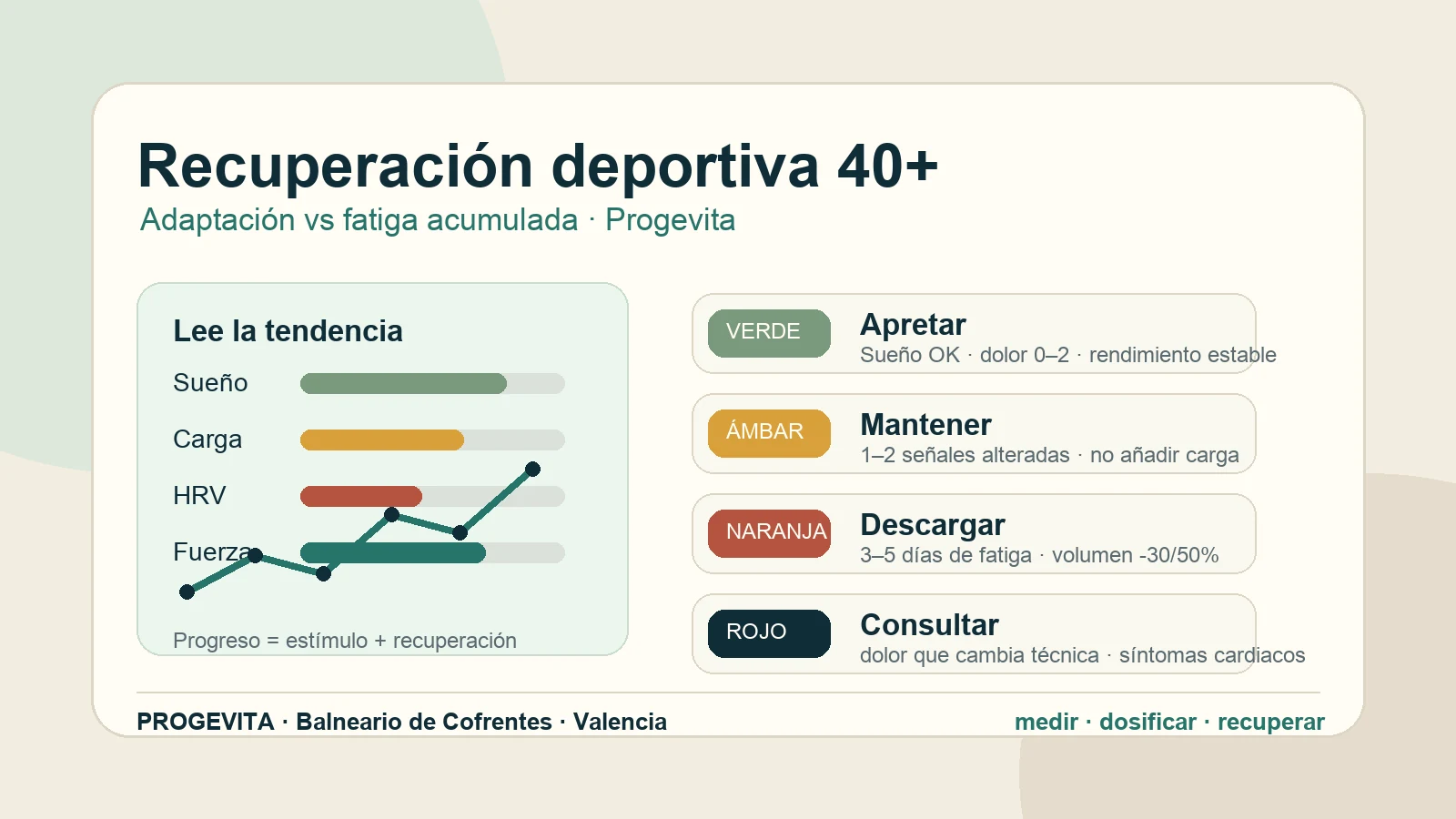
Turning 40 does not flip a switch. Learn to separate normal fatigue, poorly tolerated load, injury and medical causes without obeying every wearable reading.
Turning 40 does not flip a slow-recovery switch. Some weeks a familiar session feels twice as heavy, but your birth date rarely explains everything. Perhaps sleep was worse, food was short, mileage rose, an infection is starting or work and training have been drawing from the same reserve for too long.
The useful question is not “am I too old to recover?”. It is: what changed, which trend can I see and what small decision can I make now? This lets you train ambitiously without ignoring symptoms or turning every wearable fluctuation into an alarm.
The essentials in one minute
- Forty is not a biological border: experience, previous inactivity, sleep, health and load matter greatly.
- One tired session is not overtraining: the diagnosis needs a longer history and exclusion of other causes.
- Trends matter more than thresholds: compare performance, sensations and context across several sessions.
- HRV and pulse add context: they do not diagnose and should not govern the plan alone.
- Recovery also means eating: low energy availability can look like lost fitness or poor recovery.
- Some symptoms are not trainable: chest pain, fainting or severe breathlessness need assessment.
What we know about recovery in masters athletes
“Masters” is a sporting category that begins at different ages in different disciplines. It is not a diagnosis. A narrative review found that we know less about age-related recovery kinetics than marketing often implies, and that the effect may be smaller than assumed. More sedentary living and different training histories may explain some changes attributed to ageing.
This does not mean nothing changes. Muscle, connective tissue, sleep, disease, medication and tolerance for sudden load may change over time. Yet two 48-year-olds can need entirely different plans. Age frames a question; it does not prescribe the answer.
Normal fatigue, overload and illness are not synonyms
| Scenario | What often happens | Useful decision |
|---|---|---|
| Acute fatigue | One session temporarily reduces performance or drive; quality then returns. | Eat, sleep, move gently and respect planned recovery. |
| Functional overreaching | A planned block lowers short-term performance and may improve it after recovery. | Only useful with a goal, monitoring and an exit plan. |
| Non-functional overreaching | The fall lasts longer than expected and sleep, mood or capacity may change. | Reduce load and investigate training, health and energy. |
| Injury or medical cause | Focal pain, systemic symptoms or disproportionate fatigue do not fit the plan. | Assess without assuming that “more rest” is the whole answer. |
The ECSS/ACSM consensus separates functional overreaching, non-functional overreaching and overtraining syndrome. The distinction is often retrospective, depends on how long impairment lasts and requires exclusion of illness, inadequate food, stress and other problems. No blood test, HRV value or pain scale confirms the syndrome by itself.
Read four layers, not a rigid traffic light
- Comparable performance: what happens to the same pace, power, load or task in similar conditions? One bad day is noise; a repeated fall deserves attention.
- Subjective experience: sleep, drive, irritability, heaviness, pain and perceived effort. A systematic review found these measures often respond sensitively to load changes, though they do not diagnose alone.
- Context: travel, heat, work, menstrual cycle, alcohol, infection, energy deficit, medication or a recent competition.
- Device data: pulse, HRV, estimated sleep and load. Measure consistently and keep them as one layer.
Our guide to interpreting HRV explains why your own trend is more useful than a population table. If one reading contradicts how you feel and perform, check the measurement before rewriting the week.
A three-question weekly review
Set aside five minutes at the end of the week. You do not need a dashboard:
- Which load changed? Include duration, intensity, strength and competition, as well as work and sleep.
- Which response repeats? Look for a trend in performance, effort, pain, mood and rest.
- What is the smallest adjustment? Remove one demanding session, shorten volume, swap a run for easy cycling or keep the plan if there was only one bad day.
You do not have to deload every three, four or six weeks or cut a fixed percentage. A deload is a tool, not a ritual. It should remove enough stress to recover while preserving the practice that still makes sense for your sport.
Sleep matters, but it is not eight perfect hours for everyone
The athlete-sleep consensus recognises that schedules, travel, competition and training can disrupt rest, but it also highlights research limitations. Not everyone needs the same duration and wearables do not measure sleep like polysomnography.
Aim for a workable pattern: reasonably stable timing, enough opportunity to sleep, daylight, caffeine that fits bedtime and less alcohol. Loud snoring, breathing pauses, marked sleepiness or persistent insomnia may need clinical assessment. Our guide to causes of sleep problems helps organise that conversation.
Energy, carbohydrate, protein and fluids
Poor recovery may signal that intake does not cover output. The IOC consensus on Relative Energy Deficiency in Sport explains that low energy availability can affect women and men, with health and performance consequences. Low body weight or deliberate restriction is not always present.
The sports-nutrition position statement commonly places athlete protein around 1.2 to 2.0 g/kg/day, but that range is not a prescription for every age, sport or disease. Total energy, carbohydrate for the work performed, meal distribution and hydration matter too. Adding protein without fixing insufficient intake does not solve the problem.
Unintended weight loss, menstrual change, low libido, bone injury, persistent cold, irritability or declining performance deserve a professional conversation, not another supplement stack.
Pain: adapt load without diagnosing by colour
Soreness, stiffness and injury do not share one clock. No 0-to-10 score guarantees safety either. Notice whether pain changes technique, grows across sessions, limits daily tasks, comes with swelling or follows trauma. Our guide to sports pain after 40 develops patterns and progression.
Instead of “push or stop”, modify one variable: range, load, speed, duration, surface or exercise. If the pattern worsens, includes strength loss or does not resemble a familiar response, seek assessment.
When blood tests may help
Blood tests are useful when they test a clinical hypothesis. Persistent or disproportionate fatigue, sustained decline, recurrent infection, bleeding, breathlessness, weight or menstrual change, medication and diet may guide a blood count, iron studies, thyroid, glucose or other tests. Context chooses the test.
CK can rise after a session without indicating dangerous damage. hsCRP is non-specific. Vitamin D, cortisol, insulin and other markers are not a universal recovery panel. Before ordering them, ask which result would change the plan.
Reasons to slow down and seek care
- Urgent: chest pain or pressure, fainting, severe breathlessness, palpitations with illness, sudden weakness or neurological symptoms.
- Prompt care: dark urine with severe muscle pain or swelling after exercise, fever, acute injury, inability to bear weight or marked strength loss.
- Planned appointment: fatigue that persists despite sensible adjustments, repeated performance decline, pain that changes technique, infections, unintended weight loss or severely disrupted sleep.
Pre-exercise screening should not stop an asymptomatic person from moving, but known cardiovascular, metabolic or kidney disease and a jump to vigorous exercise may require individual advice.
Frequently asked questions
Does recovery always get worse after 40?
No. Age may play a role, but there is no sudden switch at 40. Training history, sleep, work, illness, energy availability and the session itself explain much of the variation. Evidence specifically about masters athletes remains limited.
How can I tell normal fatigue from a problem?
Look at the trend, not an exact hour count. Normal fatigue improves and lets you return to usual quality. If performance keeps falling, sleep or mood worsens, pain changes technique or fatigue does not respond to a sensible load reduction, investigate further.
How many hard days should I do each week?
There is no universal number just because you are over 40. It depends on sport, experience, true intensity, sleep, work, health and which sessions you can recover from. Space demanding stimuli enough to return with quality and adjust to your response, not a template.
Should HRV decide whether I train?
Not by itself. Compare trends measured in similar conditions and combine them with sleep, pulse, sensations, illness and performance. One reading may be noise; a coherent trend can justify reviewing load, but it cannot diagnose overtraining.
Do I need a deload week at fixed intervals?
No cadence or percentage works for everyone. You can plan easier weeks around competition or demanding blocks, or adjust when quality falls. A useful deload reduces enough stress to restore recovery without turning a fixed number into a rule.
What should I eat for better recovery?
Start by covering energy, carbohydrate for the demand, distributed protein and fluids. Needs change with sport, volume, goal and health. More protein does not fix low energy availability or replace sleep; a professional can adapt amounts when disease or restrictions matter.
When do blood tests make sense?
When fatigue is persistent, unexplained or disproportionate, performance keeps falling, infections recur, menstrual patterns change, weight loss is unintended, breathlessness appears or other symptoms develop. A clinician chooses tests from history and examination; there is no universal sports panel.
When should I stop and seek care?
Stop and seek assessment for pain that alters technique, an acute injury or fatigue that does not improve with sensible changes. Chest pain or pressure, fainting, severe breathlessness, palpitations with illness, sudden weakness or dark urine with marked muscle pain need prompt or urgent care.
Sources
- Fell J, Williams AD. Age-related changes in performance and recovery kinetics in masters athletes. J Aging Phys Act. 2016. Europe PMC.
- Meeusen R et al. Prevention, diagnosis and treatment of the overtraining syndrome. ECSS/ACSM consensus. 2013. Europe PMC.
- Saw AE et al. Monitoring the athlete training response: subjective self-reported measures. Br J Sports Med. 2016. Europe PMC.
- Walsh NP et al. Sleep and the athlete: narrative review and expert consensus recommendations. Br J Sports Med. 2020. Europe PMC.
- Thomas DT et al. Nutrition and athletic performance. Joint position statement. 2016. Europe PMC.
- Mountjoy M et al. IOC consensus statement on Relative Energy Deficiency in Sport. 2023. Europe PMC.
- O'Donnell S et al. Sleep interventions designed to improve athletic performance and recovery. Sports Med. 2018. Europe PMC.
- Riebe D et al. Updating ACSM's recommendations for exercise preparticipation health screening. 2015. Europe PMC.
Method: narrative review of consensus statements, one systematic review and papers on masters athletes, sleep, nutrition and monitoring. Ranges are references, not individual prescriptions. Sources checked 30 August 2026. This content is educational and does not replace medical or physiotherapy assessment.
Related articles

Natural light at work: sleep, fatigue and circadian rhythm
An office can be bright enough for work and still give the body clock a weak day signal. What to measure by day, reduce at night and make of the new heart findings.
Insulin Resistance: What It Means, How It Is Measured and What Actually Helps
Insulin resistance is not diagnosed from fatigue or one HOMA-IR result. This guide explains which tests change decisions and how to build a measurable plan.
What Semen Can Tell You About a Man's Health
A semen analysis may open questions about testicular health, hormones, medicines and exposures. It is neither a fertility verdict nor a longevity test.
Can a Multivitamin Slow Biological Age? What COSMOS Measured—and What It Did Not
COSMOS found a small shift in two of five epigenetic clocks after two years. Here is the effect size, the limits and when supplementation answers a real nutritional need.