Elbow pain after padel, knee pain while running or a recurring niggle: how to recognize patterns, adjust load and know when assessment makes sense.
An elbow that complains after padel or a knee that appears at mile three does not mean you have expired as an athlete. It also does not prove that pushing through is safe. The useful task is separating a load response, an injury that needs protection and a symptom that calls for assessment.
After 40, strength, sleep, available time and tolerance for sudden increases may change. Age belongs in the context; it is not a diagnosis. A week with more matches, hills, desk work and less rest may matter more than your date of birth.
The essentials
- Pain does not identify one structure: location is a clue, not the complete diagnosis.
- Modification is not surrender: changing movement, volume or intensity may preserve activity while you clarify the pattern.
- There is no universal traffic light: pain quality, function, course and warning signs matter.
- Exercise often belongs in the plan: tendon and patellofemoral loading are adapted to tolerance and goals.
- Imaging needs a question: order it when it may change a decision, not simply to prove that something exists.
Start with the pattern, not the sport
“Padel elbow” and “runner's knee” are convenient labels, but several problems share a region. Lateral elbow pain may fit tendinopathy while also receiving input from the neck, a nerve, shoulder or wrist. Anterior knee pain may look patellofemoral, but trauma, locking, swelling or instability change the reasoning.
| Pattern | Clues | What often changes the decision |
|---|---|---|
| Localized loading | Appears with a repeatable task and eases when it is reduced | Recent volume, technique, strength and later response |
| Acute injury | Trauma, a pop, rapid swelling or sudden loss of function | Prompt examination and imaging when indicated |
| Neurological | Tingling, electric pain, weakness or spreading symptoms | Neck or back, distribution and objective deficit |
| Inflammatory or systemic | Heat, fever, several joints or prolonged stiffness | Medical evaluation, not only a sports plan |
Our guide to sports recovery after 40 expands on fatigue and load. Here that information helps decide which movement can stay and which needs a pause.
Four questions for adapting a session
- What does it feel like? Familiar localized discomfort is different from sudden pain, burning, an electric sensation or chest pressure.
- What happens to function? Limping, weaker grip, locking or altered technique matter more than an isolated score.
- What happens afterwards? Notice whether usual function returns or the problem keeps escalating.
- What changed? More volume, intensity, surface, equipment, poor sleep or stress may reveal the mismatch.
Without warning signs and with stable function, try one modification: shorter duration, another variation, less impact or more recovery. Change one thing so the response is readable. If function worsens or the pattern becomes less predictable, stop experimenting and seek help.
Elbow pain after padel, tennis or golf
Lateral elbow tendinopathy often causes pain near the outside of the elbow with gripping or wrist extension. A systematic review and another review of eccentric exercise support exercise within management while showing different protocols and variable evidence quality. No home sequence confirms the diagnosis, and no set is perfect for everyone.
The first map includes playing frequency, recent increases, racket, grip size, stroke mechanics, forearm strength and shoulder control. Complete rest may calm symptoms without rebuilding tolerance; keeping the same schedule may maintain irritation. Between those extremes are movement adjustment and progressive strength based on response.
Tingling into the fingers, neck pain, marked weakness, major swelling or trauma change the pathway. The NHS public guidance on tennis elbow also advises seeking help when pain persists and notes that diagnosis uses symptoms and examination.
Knee pain while running
Patellofemoral pain is commonly felt around or behind the kneecap and may appear with running, stairs or prolonged knee flexion. International consensus supports exercise, especially knee and hip work, with other aids selected for the presentation. That does not turn every anterior knee pain problem into the same condition.
A review of interventions for running-related knee injuries found evidence of varying certainty. Technique, exercise, orthoses and multicomponent programmes may help in some contexts, but no universal cadence, shoe or insole emerged. A modification earns its place when it improves a concrete function and enables progression, not because it is fashionable.
After a twist or fall, rapid swelling, locking, instability or inability to bear weight should not be managed as simple running progression. NHS knee-pain guidance distinguishes situations that need urgent help or assessment.
Rest or movement?
Protecting an acute injury may be sensible. With persistent tendon or patellofemoral pain, waiting without activity until everything feels perfect may reduce capacity and recreate the same jump on return. A broad review of exercise therapy for tendinopathy supports exercise while comparisons between loading types and doses remain heterogeneous.
| Situation | Cautious response | Avoid |
|---|---|---|
| Stable discomfort, function preserved | Keep tolerable activity and adjust one variable | Increasing load to test the tissue |
| Pain changes movement | Change or stop that task and review the pattern | Forcing it until it warms up |
| Response progressively worsens | Reduce load and seek advice if it persists | Repeating the same session through discipline |
| Trauma or warning sign | Protect and assess according to severity | Diagnosis from social media |
The goal is not finding a pain number that grants permission. It is preserving sound function, a recoverable response and meaningful progression.
Sleep and pain: a relationship, not one explanation
A 2024 meta-analysis found a bidirectional relationship between sleep problems and chronic musculoskeletal pain. This was observational evidence: it cannot show that one poor night caused your injury or that sleep will cure it. It does justify asking about sleep when sensitivity rises and recovery falls.
Stress, energy availability, alcohol, recent illness and total load complete the context. A wearable may add trends but cannot diagnose tissue. When several parts of life are stretched, there may be less room for another intense session.
Imaging and passive treatment
MRI or ultrasound may clarify a question after trauma, deficit, locking, major swelling or an unexpected course. They may also reveal changes found in people without pain. Imaging should therefore change a decision rather than certify that pain is real.
Braces, taping, manual therapy, shockwave treatment or an injection may have a role in selected cases. Evidence and risks vary by diagnosis, duration and option. None automatically replaces education, loading and gradual return. A recent chronic-elbow trial does not make PRP or prolotherapy first-line treatment for pain that began this week.
Returning without a universal calendar
A useful return moves from tolerable tasks towards the sport's actual demands: gripping, shots and direction changes in padel; easy running, hills, speed and fatigue in running. Progress follows stable function and a recoverable response, not the end of a predetermined week.
Strength may belong in the plan, but selection depends on the pattern. Our guide to functional strength explains global capacity, while our joint-health guide separates mechanical pain, osteoarthritis and inflammatory disease.
Warning signs
Seek urgent help for deformity, inability to bear weight after trauma, a very hot joint with fever, new neurological weakness, chest pain, fainting or severe breathlessness. Arrange prompt assessment for persistent swelling, locking, loss of strength, progressive night pain or a course that does not match the load change.
Frequently asked questions
Can I keep training if it hurts?
It depends on the pattern, function and course. Stable discomfort may allow a variation or lower load; sudden pain, loss of function, deformity, major swelling or neurological symptoms require stopping that movement and seeking assessment.
Is elbow pain after padel always tennis elbow?
No. Location offers a clue, but the neck, nerves, shoulder, wrist, technique, grip and a jump in playing volume may contribute. History and examination separate causes that a sports label cannot resolve.
What usually helps lateral elbow pain?
Education, temporary activity adjustment and progressive exercise commonly form the foundation. Exact loading depends on irritability, strength and diagnosis; a brace, manual therapy or another option may complement rather than replace progression.
Can runner's knee be fixed by changing shoes?
A shoe change or foot orthosis sometimes improves symptoms, but it is rarely the whole answer. Education, load, knee and hip exercise and, in selected cases, running technique often matter in patellofemoral pain.
Should I rest until all pain disappears?
An acute injury may need protection. In many persistent pain problems, complete rest reduces capacity and does not prepare a return. Keeping tolerable activity and rebuilding load gradually is often more useful.
Do I need an MRI or ultrasound?
Not always. Imaging helps when it may change the decision, such as after trauma, locking, major swelling, neurological deficit, an unexpected course or real diagnostic uncertainty. Structural findings do not always explain pain.
Can poor sleep make sports pain worse?
Sleep and musculoskeletal pain are related in both directions. Poor sleep does not prove the cause of an injury, but it may increase sensitivity and reduce recovery, so it belongs in the context.
When should I seek urgent help?
Seek urgent care for deformity, inability to bear weight after trauma, a very hot joint with fever, new neurological weakness, chest pain, fainting or severe breathlessness. Other persistent changes need scheduled assessment.
Sources
- Landesa-Piñeiro L et al. Physiotherapy interventions for lateral epicondylitis: systematic review. J Back Musculoskelet Rehabil. 2022. Europe PMC.
- Yoon SY et al. Eccentric exercise for lateral elbow tendinopathy: systematic review and meta-analysis. J Clin Med. 2021. Europe PMC.
- Cooper K et al. Exercise therapy for tendinopathy: systematic review and evidence synthesis. 2023. Europe PMC.
- Collins NJ et al. International consensus statement on exercise therapy and physical interventions for patellofemoral pain. Br J Sports Med. 2018. Europe PMC.
- Alexander JLN et al. Strategies to prevent and manage running-related knee injuries: systematic review. Br J Sports Med. 2022. Europe PMC.
- Runge N et al. Sleep problems and chronic musculoskeletal pain: systematic review and meta-analysis. Pain. 2024. Europe PMC.
- NHS. Tennis elbow. NHS.
- NHS. Knee pain. NHS.
Method note: editorial and source review completed on 30 August 2026. Patterns guide without self-diagnosis; no numerical traffic light, universal rehabilitation protocol or commercial recommendation is provided.
Related articles
VO₂ Max After 40: Read the Number and Train with Perspective
What VO2 max tells you, why a watch and a gas-analysis test are not equivalent, how to follow the trend and when assessment makes sense before adding intensity.
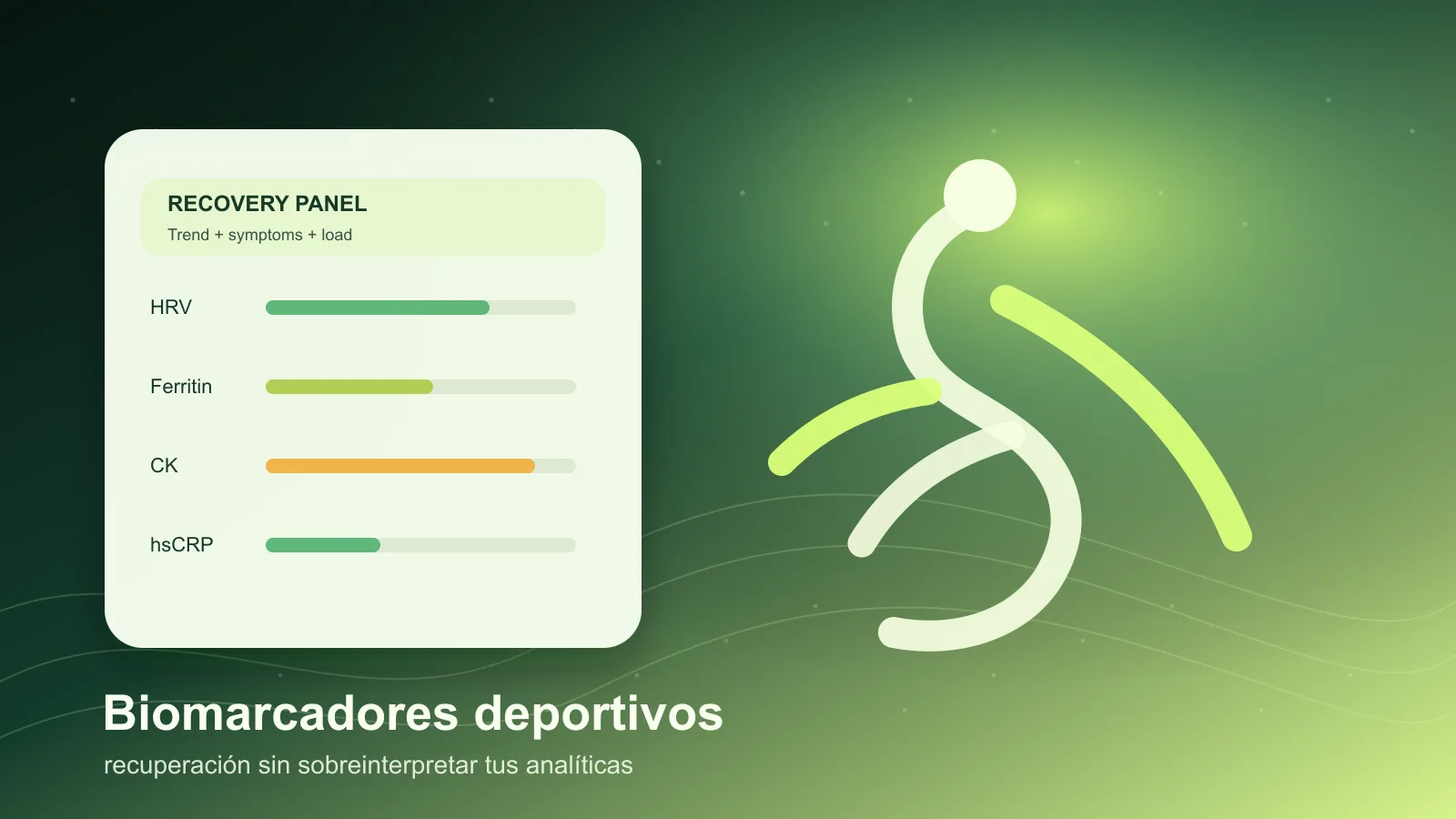
Recovery Biomarkers for Athletes: What They Add and When to Stop Measuring
A watch or blood test can clarify a question, but neither should dictate every session. Read HRV, iron, CK and RED-S without turning normal variation into alarm.
Hyperbaric Oxygen: Evidence-Based Uses, Risks and Limits
Hyperbaric oxygen treats specific medical problems, but it has not been shown to extend life. We separate accepted indications, anti-aging studies and marketing.

Metformin and Longevity: What to Know Before Asking for It
Metformin treats type 2 diabetes and may prevent it in selected high-risk people, but it has not been shown to slow aging in healthy adults. How to decide without copying an online dose.