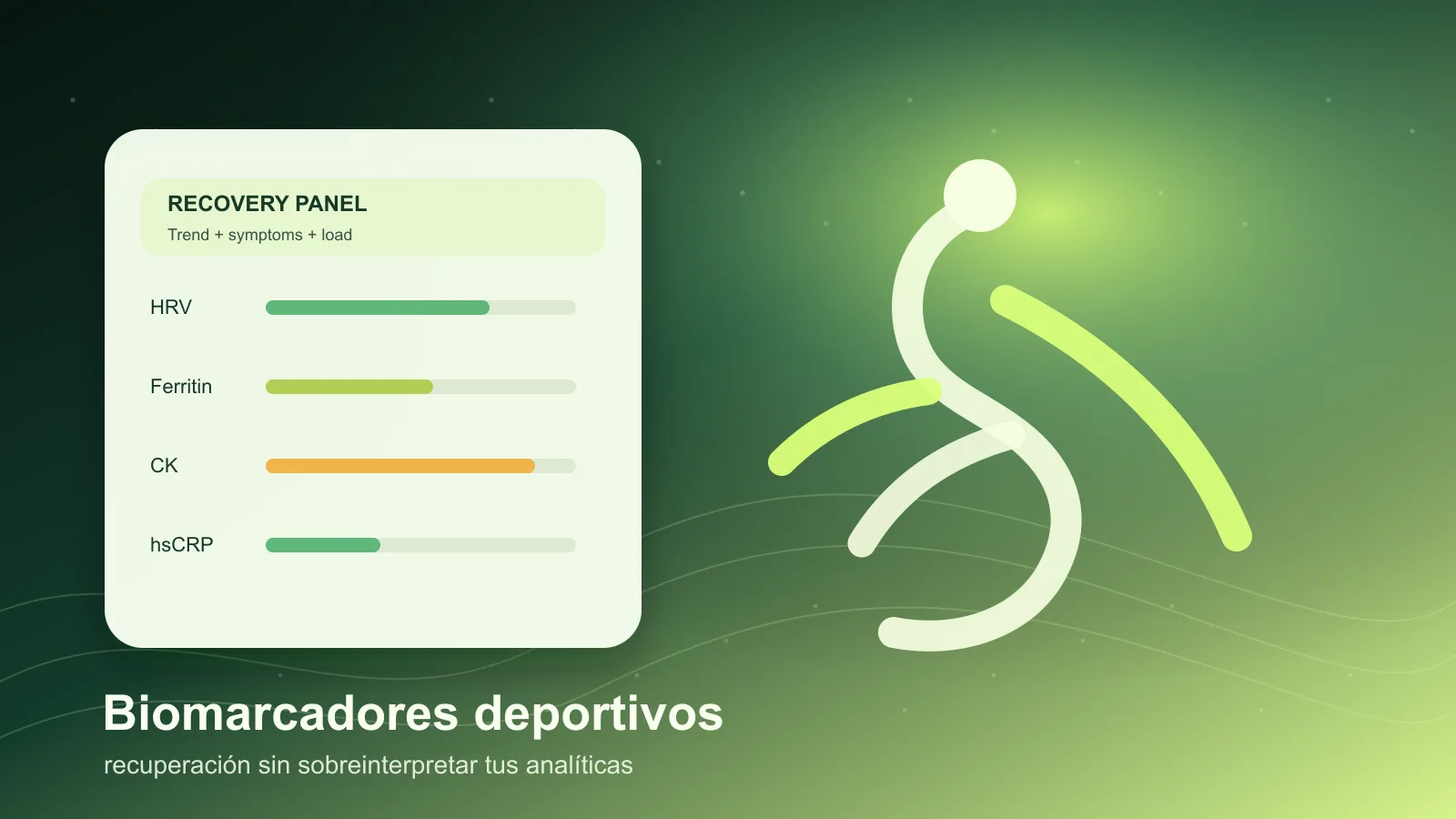
A watch or blood test can clarify a question, but neither should dictate every session. Read HRV, iron, CK and RED-S without turning normal variation into alarm.
Some mornings your watch paints everything red, yet your legs feel surprisingly light. On other days the numbers look immaculate while the warm-up feels like a climb. That contradiction does not make data useless. It means data needs a conversation.
A biomarker is one piece of information, not a verdict. It may help explain fatigue, guide a test or follow a known abnormality. It cannot decide by itself whether you have recovered, become injured or developed “overtraining”. The better question is not “which panel should I order?” but “which uncertainty am I trying to reduce, and what would I change after the result?”.
What matters most
- Start with function: how you perform, feel and respond to load.
- Look for trends: a consistent method and context matter more than a dramatic reading.
- Test with a question: testing without a hypothesis can create noise, expense and false alarms.
- Do not normalise decline: persistent symptoms or warning signs need assessment.
Before the number, ask four simple questions
Recovery starts outside the laboratory. Across several days, observe four layers:
- Performance and function: are pace, power, coordination and everyday tasks holding steady?
- Symptoms: is there fatigue, pain, irritability, dizziness, illness, menstrual change or different sleep?
- Load and context: did volume or intensity rise, or did travel, sleep, food or an infection change?
- Direction: does the pattern improve after a sensible load adjustment or keep worsening?
The record does not need to be perfect. A short note often adds more than an isolated screenshot. If the main question is how to arrange fatigue and sessions, the guide to sports recovery after 40 expands that process. If pain is changing your technique, read how to adapt sport around pain.
HRV: a useful trend and a poor traffic light
Heart rate variability, or HRV, reflects changes in autonomic regulation between beats. Bellenger and colleagues' systematic review found potential value for monitoring adaptation to training, but methods and individual responses vary. Comparing your own trend under similar conditions is more sensible than chasing a universal “good” number.
Device, posture, timing, breathing, alcohol, illness and sleep can move the reading. One low morning does not require cancelling a session. Several days outside your pattern, together with worse sleep, a higher resting heart rate, unusual fatigue or lower performance, can justify reviewing the load.
HRV cannot replace how you feel or a clinical assessment. It also cannot measure iron, infection, injury or energy availability. This guide to heart rate variability explores signal, noise and measurement habits in more detail.
Blood work: ordering less can reveal more
There is no universal athlete panel. Selection depends on symptoms, history, diet, medication, sex, sport, training phase and examination. An athlete with fatigue and heavy menstrual bleeding raises different questions from someone with fever, unintended weight loss or severe muscle pain after an endurance event.
Conditions before the sample matter too. Recent exercise, dehydration, illness, time of day and some medicines can alter results. Haller and colleagues' review of blood-based workload markers emphasises serial measurements, comparable conditions and performance data. A value outside a laboratory interval does not automatically mean disease or poor recovery.
| Data | What it may add | What it cannot prove alone |
|---|---|---|
| HRV and pulse | Autonomic trend and daily context | Exact readiness or a diagnosis |
| Blood count and iron | Anaemia and iron status within clinical evaluation | The full cause of fatigue |
| CK | Muscle response shaped by recent exercise | Injury or overtraining |
| Hormones | One part of an endocrine or energy question | RED-S from one result |
Iron and ferritin: important, with context
Iron supports oxygen transport and energy metabolism. Deficiency matters in endurance sport and may arise with low intake, menstrual loss, other losses or high demand. A recent systematic review in female athletes found that deficiency can impair performance and that correction may help when a true deficiency is present.
Ferritin cannot be read alone. Inflammation may raise it, and interpretation may involve a blood count, other iron indices, symptoms and clinical context. Taking iron without confirming the problem can cause adverse effects and obscure why iron is being lost. When deficiency is suspected, investigate the cause and agree follow-up with a professional.
CK: a hard session does not tell the whole story
Creatine kinase, or CK, may rise after strength work, downhill running, long races or unfamiliar movement. Individual responses are enormous, so comparing your result with a training partner is rarely useful. Sampling time, pain, weakness, hydration and direction of change all influence interpretation.
High CK without severe symptoms does not diagnose injury or overtraining syndrome. Disproportionate muscle pain, marked weakness or dark urine after exercise may fit exertional rhabdomyolysis and need prompt care. Bäcker and colleagues' review shows why the clinical picture, not an isolated number, directs assessment.
RED-S: when available energy does not cover demand
Relative Energy Deficiency in Sport, or RED-S, may occur when energy remaining for normal body functions is insufficient after training demand. The International Olympic Committee consensus describes possible effects on health and performance in athletes of any sex.
Menstrual changes, low libido, unintended weight loss, bone stress injuries, repeated illness, altered mood or flat performance may be part of the picture, but none is exclusive. No single hormone confirms or excludes RED-S. Diet, load, symptoms, hormonal function, bone health and context belong together.
Overtraining syndrome has no definitive test
Normal fatigue, functional overreaching and overtraining syndrome are not interchangeable. The Meeusen consensus and reviews by Roete and Carrard share one central limitation: no biomarker diagnoses the syndrome on its own. Assessment considers prolonged performance decline and excludes other medical and psychological explanations.
That matters because anaemia, infection, endocrine disease, low energy availability, inadequate sleep or poorly tolerated load may look similar. Labelling yourself “overtrained” too early may delay the real explanation. The laboratory answers focused questions; it cannot replace history, examination and follow-up.
A more useful conversation with your clinician
Bring a representative week of training, symptoms, sleep, food and recent changes. List medicines and supplements and explain what has stopped working. “My power has fallen for three weeks and I am also dizzy” guides a conversation better than “I want every biomarker”.
Before repeating a test, ask which decision it could change. Sometimes the answer is to adjust load and observe. In other situations it may make sense to investigate iron, infection, thyroid function, energy availability or another cause. Good measurement reduces uncertainty instead of collecting numbers.
When to stop and ask for help
Seek care for chest pain or pressure, fainting, severe breathlessness, palpitations with distress, marked weakness or dark urine after exercise. Persistent performance decline, unintended weight loss, fever, dizziness, major hormonal changes, repeated injury or fatigue that does not improve after sensible adjustments also deserves assessment.
Frequently asked questions
Is there one biomarker that shows I have recovered?
No. Recovery is interpreted by combining performance, symptoms, load, sleep and context. A measurement can add information, but no single value can summarise whether you are ready to train.
Should HRV decide today's training?
Not on its own. A trend measured with the same device and method can support an adjustment when it agrees with worse sleep, greater fatigue or lower performance. A single reading may be noise.
Does high CK mean injury or overtraining?
Not necessarily. CK can rise substantially after strength work, downhill running, a long race or novel exercise, and it varies between people. Timing, symptoms and the direction of change shape its meaning.
Can low ferritin affect performance?
Yes. Iron deficiency can accompany fatigue and poorer performance, even before clear anaemia. Ferritin also changes with inflammation, so it needs context and does not justify taking iron blindly.
Can blood work diagnose overtraining syndrome?
No. There is no definitive test. Assessment requires prolonged performance decline, symptoms, load and recovery, while excluding problems such as infection, anaemia, endocrine conditions or low energy availability.
What is RED-S, and can one hormone detect it?
RED-S describes consequences of insufficient energy availability for sporting demand. It can affect athletes of any sex and several body systems. Diet, load, symptoms, menstrual or sexual function and bone health matter more than one hormone.
How often should I repeat sports blood work?
There is no universal timetable. Repeat testing makes sense when there is a clinical question, an abnormality is being followed or the result could change a decision. If training is going well and symptoms are absent, more tests do not guarantee better choices.
When should I stop and seek care?
Seek care for chest pain, fainting, severe breathlessness, palpitations with distress, marked weakness, dark urine after exercise or persistent deterioration. Prolonged performance loss, unintended weight loss or repeated injuries also deserve assessment.
Sources
- Bellenger CR et al. Monitoring Athletic Training Status Through Autonomic Heart Rate Regulation. Systematic review and meta-analysis. Europe PMC.
- Roete AJ et al. Markers of Functional Overreaching in Endurance Athletes. Systematic review. Europe PMC.
- Carrard J et al. Diagnosing Overtraining Syndrome. Scoping review. Europe PMC.
- Meeusen R et al. Prevention, Diagnosis and Treatment of the Overtraining Syndrome. Joint consensus statement. Europe PMC.
- Haller N et al. Blood-Based Biomarkers for Managing Workload in Athletes. Europe PMC.
- Pengelly M et al. Iron Deficiency, Supplementation and Sports Performance in Female Athletes. Systematic review. Europe PMC.
- Mountjoy M et al. IOC Consensus Statement on Relative Energy Deficiency in Sport. Europe PMC.
- Bäcker HC et al. Exertional Rhabdomyolysis in Athletes. Systematic review. Europe PMC.
Method note: editorial and source review completed on 30 August 2026. Everyday monitoring, clinical investigation and diagnosis are kept separate; no biomarker, panel or testing timetable is presented as universal.
Related articles

VO₂ Max After 40: Read the Number and Train with Perspective
What VO2 max tells you, why a watch and a gas-analysis test are not equivalent, how to follow the trend and when assessment makes sense before adding intensity.

Pain During Sport After 40: How to Adapt Without Stopping Blindly
Elbow pain after padel, knee pain while running or a recurring niggle: how to recognize patterns, adjust load and know when assessment makes sense.
HRV: How to Read Heart Rate Variability Without Obsessing
HRV can add context about recovery, but it is not a health grade. Learn how to compare it properly, spot noise and decide without obeying every wearable alert.
DunedinPACE and aging speed: how to read a 0.57x result
A 0.57x result does not mean living almost twice as long. Here is what DunedinPACE measures, why it can change and when repeating it may be useful.