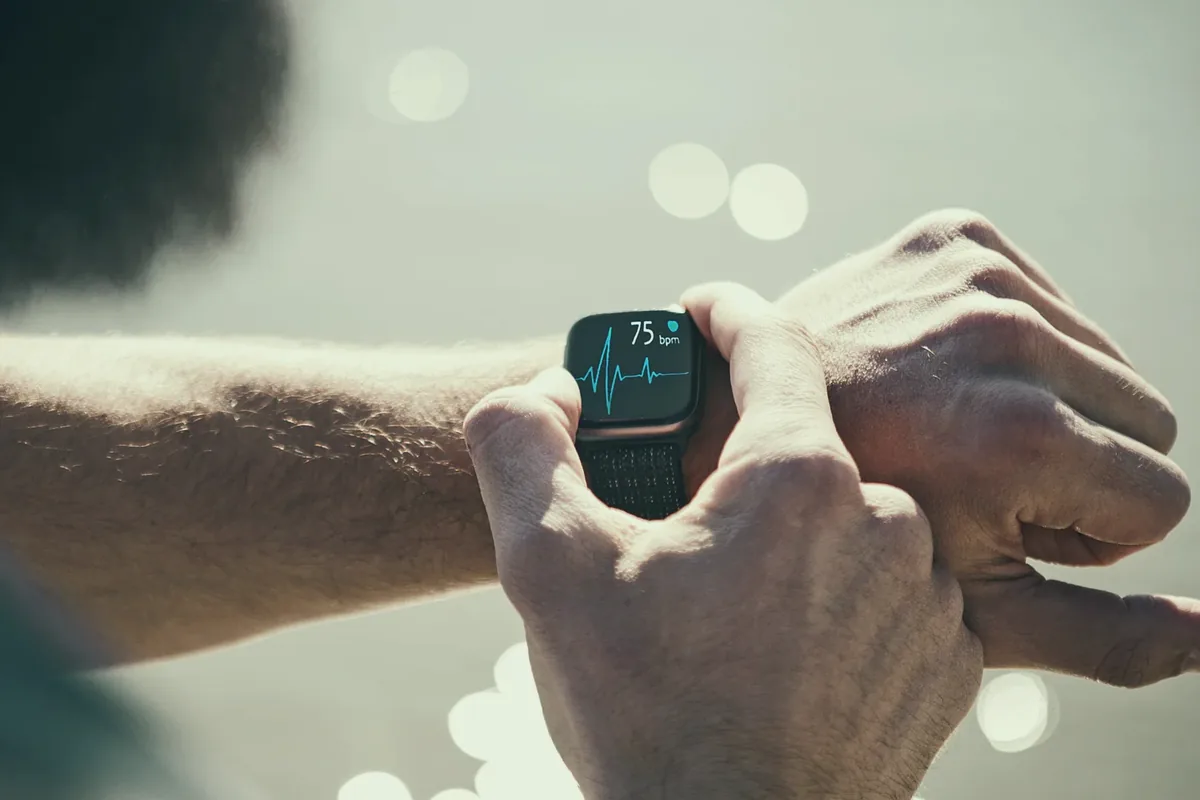
HRV can add context about recovery, but it is not a health grade. Learn how to compare it properly, spot noise and decide without obeying every wearable alert.
Your wearable says recovery is mediocre, but you wake up ready to move. Which one should you trust? Neither in isolation. Heart rate variability, or HRV, can add context. It is not a verdict, a stress detector or a daily health grade.
Used well, it helps reveal patterns between sleep, alcohol, training, illness and how you feel. Used badly, it turns an ordinary morning into a small clinical trial. This guide has one aim: make the metric work for you, not the other way around.
The short answer
- There is no ideal number: method, age, pulse and device change the reading.
- Compare with yourself: use the same metric and conditions over several weeks.
- Decide with context: HRV, resting pulse, sleep, symptoms and performance belong together.
What HRV actually measures
The heart does not beat like a metronome. Even at 60 beats per minute, one interval might last 0.94 seconds and the next 1.06. HRV summarizes those differences between consecutive intervals. ECG analysis normally focuses on beats classified as normal because ectopic beats, atrial fibrillation and artifacts can inflate variability without indicating better regulation.
Breathing makes part of the phenomenon easy to see. Heart rate tends to rise slightly during inhalation and fall during exhalation. Vagal modulation contributes, but HRV does not separate sympathetic and parasympathetic activity into two tanks or reveal “73% stress”. Posture, breathing rate, temperature, food, time, exercise, medication and illness also affect it.
A number can therefore be useful without being specific. A fall tells you that something changed in the signal or context. It cannot tell you what changed by itself.
RMSSD, SDNN and proprietary scores
| Reading | What it summarizes | Common mistake |
|---|---|---|
| RMSSD | Rapid interval changes; common in short recordings and recovery tracking | Comparing it with another device's SDNN |
| lnRMSSD | A logarithmic transformation of RMSSD to stabilize its distribution | Reading it as milliseconds |
| SDNN | Total variability inside the recorded window | Mixing seconds, five minutes and an entire night |
| Readiness or recovery | A brand-specific combination of HRV, sleep, pulse and other inputs | Treating an opaque algorithm as a diagnosis |
| LF/HF | A ratio between frequency bands | Translating it into a simple sympathetic/parasympathetic balance |
You do not need the most sophisticated metric. You need to understand the one you already receive and preserve the method. If one app shows SDNN and another RMSSD, both can be internally consistent while displaying very different numbers.
Why there is no normal-by-age table
HRV tends to decline with age at population level, but that does not create an individual diagnostic cutoff. Shaffer and Ginsberg's review of norms warns that recording length, age and sex change values, and that 24-hour, short-term and ultra-short recordings are not interchangeable.
The Lifelines study is a useful example. It analyzed ten-second ECGs from 84,772 people and found clear age and sex differences. That is valuable population evidence, but its median cannot be copied onto a ring averaging several hours of sleep. The signal, filter and recording window differ.
Your cleanest comparison is longitudinal. Let the device collect several weeks, observe your usual range and start a new baseline when you change brand, wrist, ring or method. Someone else's 80 ms versus your 32 ms does not prove better recovery or longer life.
How to measure without manufacturing noise
Two approaches are reasonable. A wearable can estimate overnight HRV using photoplethysmography, which detects blood-volume changes in the skin. A chest strap or compatible sensor can record a few minutes in the morning. Neither is automatically superior when the signal is stable and comparison remains consistent.
- Choose one method. Do not alternate ring, watch and strap to build one trend.
- Repeat the context. For morning readings, keep timing, posture and duration similar, before caffeine or exercise.
- Breathe normally. Slow breathing raises HRV during practice and changes the comparison.
- Check signal quality. Motion, loose contact, cold skin and algorithm changes produce artifacts.
- Record four things. Sleep, alcohol, training and symptoms often explain more than another metric.
A 2025 review of cardiovascular wearables notes that these devices combine sensors with proprietary algorithms. They can support monitoring, but validation and transparency vary. A separate optical-sensor study also found differences by device and activity. A watch may offer a separate ECG feature, but that does not turn its overnight HRV estimate into continuous ECG.
A decision matrix without drama
| Pattern | Careful reading | What to do today |
|---|---|---|
| Inside your range and you feel well | No important new signal | Follow the planned day |
| One low day without symptoms | Normal variation, poor signal or a short-lived load | Note the context and wait for the trend |
| Several low days, higher pulse and fatigue | Under-recovery, alcohol, poor sleep or illness are possibilities | Reduce intensity, sleep, eat enough and review symptoms |
| A repeated very high or erratic value | Artifact or irregular rhythm may be present | Check fit; seek assessment if symptomatic |
HRV can enrich training decisions but should not direct them alone. In a 2025 study, 28 male cyclists improved under different protocols, while the group combining HRV, pulse and well-being showed some larger gains. That is a small, specific result, not a universal instruction. Our guide to sports recovery after 40 integrates load, pain, sleep and performance.
What commonly moves the trend
Sleep
A 2025 review of eleven experimental studies found that sleep deprivation reduced RMSSD, although not every index changed consistently. That supports context, not the ability to diagnose one bad night from a watch. When sleep is the real problem, our guide to sleep regularity and recovery offers a more useful plan than chasing the score.
Alcohol
A 2026 retrospective analysis of WHOOP users associated drinking above each person's usual level with lower HRV, higher nocturnal pulse and less sleep. The dataset is enormous, but the company funded the study and employed several authors. Treat it as a coherent signal for a personal experiment, not an exact estimate of what each drink does.
Exercise and energy availability
A hard session can transiently reduce HRV. Sustained training may improve autonomic regulation, but the response depends on mode, load and baseline. Eating too little, dehydration or stacking hard sessions without recovery can also shift the signal. To measure aerobic capacity, our VO2 max guide answers a different and more specific question.
Slow breathing
Slow breathing can increase respiratory heart rate variability during those minutes and help you relax. It is valid for how it makes you feel, not as a trick for producing a prettier score. Measure beforehand or always use the same protocol when comparison is the goal.
Can HRV improve?
It can change, but maximizing it should not be the goal. A life with reasonable sleep, physical activity, low or no alcohol, enough energy and treatment of apnea, pain or disease provides better conditions for regulation. HRV may move with the improvement; if it does not, function and symptoms still take priority.
Try a fourteen-day experiment:
- use the same device and avoid seeing the value until you have noted how you feel;
- record sleep, alcohol, training and symptoms in one line;
- do not add supplements or change five habits at once;
- at the end, look for repeated patterns rather than perfect correlation.
If the wearable increases anxiety or controls every decision, hiding the score for a week is also a valid experiment. Health data loses value when it worsens your relationship with your body without improving a decision.
During a thermal stay, HRV should only work as a secondary signal: useful when it confirms rest or excessive load, unhelpful when it replaces pain, sleep, blood pressure and symptoms. For that use case, our guide to mineral-water balneotherapy proposes measuring goal, tolerance and safety before and after the cycle.
HRV and longevity: association is not destiny
A 2022 meta-analysis found that low values across several HRV metrics were associated with higher all-cause and cardiac mortality in healthy and clinical populations. That does not show that raising HRV through breathing extends life. The metric may reflect age, disease, medication, fitness and heart rate, among many factors.
HRV is therefore not a biological clock, frailty test or stand-alone treatment target. It can be a monitoring window. Real cardiovascular prevention still depends on blood pressure, lipids, smoking, diabetes, activity, sleep and attention to symptoms.
When to leave the dashboard and seek care
One low value without symptoms rarely needs medical attention. Seek assessment for new or sustained palpitations, chest pain, fainting, breathlessness, marked weakness or persistently high pulse. An extreme repeated reading also deserves a sensor and rhythm check, especially with atrial fibrillation, frequent ectopic beats or a pacemaker.
Commercial disclosure: Progevita offers medical assessment and monitoring of habits and physical capacity. That does not show that everyone needs HRV tracking, a wearable or a private programme. The metric deserves space only when it changes a useful decision.
Frequently asked questions
What does HRV measure?
HRV measures variation in time between consecutive heartbeats, usually intervals classified as normal. It summarizes part of autonomic regulation and its interaction with breathing, sleep, activity and physiological load, but it does not directly measure stress or overall health.
What is a normal HRV?
There is no universal normal value. Age, heart rate, posture, breathing, recording length, metric, device and algorithm all change the result. Compare the same measurement with your own pattern over several weeks; another population's table is not a diagnosis.
Is higher HRV better?
A relatively high and stable HRV may accompany good recovery, but more is not always better. An unusual jump may be noise or an irregular rhythm, and a low value may be normal for you. Trend, signal quality, pulse, symptoms and context all matter.
Which metric should I use, RMSSD or SDNN?
Use the metric your device provides consistently. RMSSD is common in short recordings and recovery tracking; SDNN depends especially on recording length. Do not compare RMSSD with SDNN or an entire night with a seconds-long ECG.
Is HRV from a watch or ring reliable?
It can be useful for trends when the sensor fits well, the algorithm stays stable and conditions repeat. Most use photoplethysmography rather than continuous ECG and can fail with motion or poor signal. HRV alone cannot diagnose an arrhythmia.
Should HRV decide whether I train?
Not by itself. One reading should not cancel a session when you feel well. If the trend falls for several days alongside higher pulse, poorer sleep, fatigue or lower performance, reducing load and reviewing recovery or illness may be sensible.
How can I improve HRV?
Do not chase the score. Reasonable sleep timing, well-dosed exercise, less alcohol, adequate food and hydration, and treatment of medical problems may improve the physiological context. Slow breathing can raise HRV during practice but cannot hide inadequate recovery.
When should unusual or low HRV prompt medical advice?
Seek care for symptoms, not one isolated number: new palpitations, chest pain, fainting, breathlessness, marked weakness or persistently high pulse need assessment. If an extreme reading repeats, check the sensor and discuss it with a clinician.
Sources
- ESC/NASPE Task Force. Standards for HRV measurement and interpretation. Circulation. 1996.
- Shaffer F, Ginsberg JP. HRV metrics and norms. Frontiers in Public Health. 2017.
- Tegegne BS et al. Reference values from ten-second ECGs in Lifelines. European Journal of Preventive Cardiology. 2020.
- Jamieson A et al. Consumer wearables in cardiovascular health. npj Cardiovascular Health. 2025.
- Bent B et al. Sources of inaccuracy in optical heart-rate sensors. npj Digital Medicine. 2020.
- North JR et al. Test-retest reliability of resting HRV. International Journal of Psychophysiology. 2026.
- Alfonso C et al. Training guided by HRV, pulse and well-being in cyclists. Scientific Reports. 2025.
- Zhang S et al. Sleep deprivation and HRV: systematic review and meta-analysis. Frontiers in Neurology. 2025.
- Grosicki GJ et al. Alcohol, pulse, sleep and activity in real-world data. PLOS Digital Health. 2026.
- Jarczok MN et al. HRV and mortality: systematic review and meta-analysis. Neuroscience & Biobehavioral Reviews. 2022.
- Menuet C et al. Recommendation on respiratory heart rate variability. Nature Reviews Cardiology. 2025.
Method: narrative review of the linked standards, validation studies, cohorts and reviews. Values are not transferred across metrics or recording windows, and HRV is not presented as a diagnosis. Sources checked 29 August 2026. This article is educational and does not replace a consultation.
Related articles
Recovery Biomarkers for Athletes: What They Add and When to Stop Measuring
A watch or blood test can clarify a question, but neither should dictate every session. Read HRV, iron, CK and RED-S without turning normal variation into alarm.
VO₂ Max After 40: Read the Number and Train with Perspective
What VO2 max tells you, why a watch and a gas-analysis test are not equivalent, how to follow the trend and when assessment makes sense before adding intensity.

Melatonin for Sleep: What to Expect, Timing and Risks
Melatonin can help in specific situations, but it is neither a universal sedative nor an anti-aging treatment. Learn how insomnia, circadian delay and exaggerated claims differ.

Pain During Sport After 40: How to Adapt Without Stopping Blindly
Elbow pain after padel, knee pain while running or a recurring niggle: how to recognize patterns, adjust load and know when assessment makes sense.