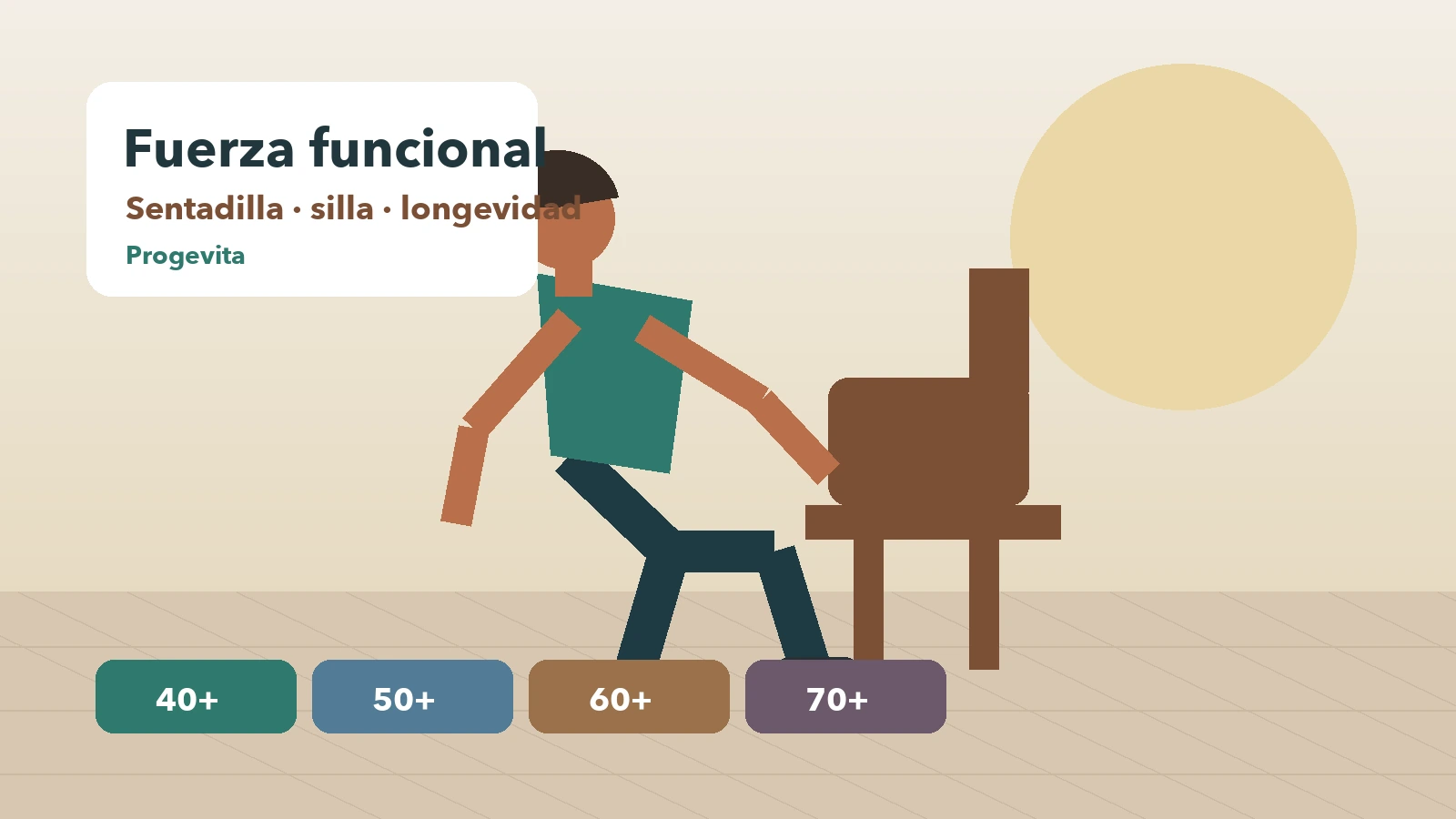
Standing up from a chair offers a clue about strength, not a score. How to observe the movement, progress sensibly and know when to seek help.
Some days, standing up from the sofa with a mug in your hand barely earns a thought. On others, you notice yourself reaching for the armrest, using momentum or shifting all your weight onto one leg. That small change is not an exam about your age. It is a clue worth meeting with curiosity.
Standing from a chair combines leg strength, mobility, balance, coordination, confidence and even seat height. It can help you observe function, but it cannot give you a grade or diagnose sarcopenia at home. The useful question is not “am I good for my age?” It is “what would help me move with more safety and reserve?”.
The key idea
- The chair offers a clue: several abilities and the setting shape the result.
- Your decade does not dictate your routine: history, health and current ability matter more than a birthday.
- Strength is adaptable: support, height, range, speed and load create a useful variation.
- Progress is not punishment: control and recovery come before a little more difficulty.
- Red flags take priority: chest pain, fainting, neurological symptoms or falls need another route.
What a chair can tell you and what it cannot
Geriatric and rehabilitation settings use chair-rise tests to assess lower-limb strength or physical performance. The European EWGSOP2 consensus includes the chair stand among ways to assess strength when investigating sarcopenia. A single test still does not confirm the diagnosis: muscle quantity or quality, physical performance, symptoms and clinical assessment also matter.
The seat changes the task considerably. A low chair asks for more range and force; using the arms makes it easier; pain, fear of falling or limited ankle movement can alter the pattern. Even rushing changes technique. Comparing yourself with a video or cut-off without matching conditions can create needless alarm.
Grip strength and leg-performance tests are associated with health outcomes in large cohorts. The PURE study, for example, found that lower grip strength was associated with higher mortality. That does not mean squeezing a dynamometer prevents disease or that weakness is always the cause. Strength can reflect age, illness, nutrition, activity and other factors.
How to observe the movement without turning it into a race
If you have no acute pain, dizziness, recent fall or surgery, you can use a stable chair against a wall. The first goal is not to move as fast as possible. It is to notice how you move.
- Begin as you normally would. Notice whether you use your hands, momentum or one leg more than the other.
- Try a safe variation. Bring your feet closer, lean forward slightly and stand with control.
- Record the experience. Note pain, unsteadiness, breathlessness and effort, not only repetitions.
- Repeat under similar conditions. A trend using the same chair is more useful than an improvised comparison.
If you need your hands, you have not failed. You can train from there. A higher chair, firm cushion or stable support reduces difficulty. Over time, the support can become lighter or the seat slightly lower.
Age informs the plan, but does not write it
Two 65-year-olds may need opposite programmes. One may have trained for decades and want to preserve power; another may be returning after illness; a third may be afraid of falling. Sorting them only by decade hides what actually changes the decision.
| Question | Why it matters | How it shapes the start |
|---|---|---|
| What do you do now? | Experience shapes technique and tolerance. | Basic learning or more advanced loading. |
| Is there pain? | It may change range, support and exercise selection. | A tolerable variation and assessment if it persists. |
| Have you fallen? | Balance, vision, medication and environment may contribute. | Nearby support and supervised specific work. |
| What is your health context? | Heart, bone, nerve, surgery and medication can change risk. | Clearance or supervision when appropriate. |
| What do you want back? | Stairs, floor, luggage and sport require different capacities. | Exercises linked to a real task. |
Strength loss does not follow an unavoidable birthday schedule. Older adults can gain strength through resistance training. The NSCA position statement emphasizes progression and individualization, including at advanced ages. If you want to understand the difference between strength, muscle mass and function, our guide to sarcopenia and muscle loss develops that distinction.
The movement patterns that support daily life
No single exercise is compulsory. Several daily tasks are worth preserving, and each can be trained in different ways:
- Sit and stand: chair, box, leg press or assisted squat.
- Hinge and pick up: hip hinge, bridge or lifting from a comfortable height.
- Push and pull: wall, band, machine or weights.
- Carry: bags, dumbbells or a well-held everyday object.
- Step and brake: low step, calf work and controlled descents.
- Balance and react: support changes, turns and tasks with nearby support.
The WHO recommends that adults strengthen the major muscle groups on at least two days each week. For older adults, it also highlights multicomponent activity that includes balance and strength to maintain function and prevent falls. This is public-health guidance, not a gym requirement or an identical dose for everyone.
A starting week that fits real life
This is an example, not a prescription. Choose variations you can control and leave enough margin to finish with steady technique.
| Session A | Session B | Between sessions |
|---|---|---|
| Stand from a chair | Hinge or bridge | Walk and change posture |
| Pull with a band or machine | Push against a wall or bench | Practise balance with support |
| Carry a comfortable load | Low step or calf work | Support sleep and eat enough |
Begin with a small number of sets and repetitions that do not distort the movement. Rest as needed. When you can repeat the task with control and recovery is as expected, change one variable: a little more range, one more repetition, less support or a small amount of load. This helps you see what produced the response.
Pain and training cannot be interpreted with one universal number. New, increasing or night pain, or pain that changes how you walk, deserves review. Our guide to recovery and fatigue after 40 explains how to read trend and context without using a wearable as diagnosis.
Strength, balance and falls
The Cochrane review by Sherrington and colleagues found that exercise programmes reduce the rate of falls in older people living in the community. Useful programmes commonly include functional and balance exercises, often alongside strength. This does not mean one squat prevents every fall: vision, medication, footwear, environment and some diseases also matter.
If you have fallen, hold onto furniture, experience vertigo or feel afraid to move, you do not need to prove anything without support. A medical or physiotherapy assessment can review balance, gait, blood pressure, vision, medication and environment, then build a safer start.
Bone, muscle and food: support, not shortcuts
With osteopenia or osteoporosis, resistance and balance training can be part of care. The Too Fit To Fracture consensus recommends individualization, especially after vertebral fracture or with high fall risk. Avoiding all effort out of fear also has a cost; adapting and supervising is often the way forward.
Muscle needs energy and protein, but no single number suits every age and medical condition. Appetite, weight, kidney function, medication and goals change the conversation. Before buying supplements, check whether you eat enough, spread protein sources you tolerate and can train consistently.
Body composition can add context when a clinical or nutrition decision requires it. It does not replace function: a lean-mass number cannot tell you by itself how you climb stairs. This guide to DEXA, bone and muscle explains what the scan can and cannot measure.
When to stop and when to seek assessment
Seek urgent care for chest pain or pressure, fainting, severe breathing difficulty, abrupt confusion, sudden loss of strength or sensation, or inability to bear weight after a fall.
Ask for assessment before progressing after repeated falls, recent fracture or surgery, persistent pain, rapid or asymmetric strength loss, unintentional weight loss, dizziness on standing or an uncontrolled condition. If you simply need your hands to stand and otherwise feel well, start with an easier variation and consider support if you do not improve or do not feel safe.
Frequently asked questions
What does standing from a chair without using your hands show?
It offers a clue about leg strength, balance, mobility and coordination. It does not measure one ability or diagnose a disease. Pain, technique, chair height and context all change the result.
Does the chair-stand test diagnose sarcopenia?
No. It can be one part of a strength or performance assessment, but sarcopenia requires a broader clinical evaluation. A slow or difficult result is a reason to investigate, not a label to apply at home.
Do I have to squat to build strength?
You do not need a deep squat or a barbell. The sit-to-stand pattern can be trained with a high chair, support, partial range, a leg press or another variation you can control without forcing pain.
How many strength days are recommended?
The WHO recommends strengthening the major muscle groups on at least two days per week for adults. That is a population starting point, not an identical prescription: health, experience and recovery shape the dose.
Should my routine change when I turn 50, 60 or 70?
Not because of the birthday itself. Current ability, training history, health conditions, medication, pain, falls and goals matter more. Age adds context but does not replace individual assessment.
How do I know when to progress?
Progress one variable when you can repeat the movement with control, technique stays steady and recovery is as expected. Add a little range, repetition or load. If new symptoms appear, return to the tolerable level and review the cause.
Can I strength train with osteoporosis?
For many people, strength and balance work are part of bone care, but exercise should be adapted. A vertebral fracture, recent fall, new pain or frailty is a reason to seek professional supervision before progressing.
When should I stop and seek help?
Stop and seek urgent care for chest pain, fainting, severe breathing difficulty or a sudden neurological symptom. Arrange assessment for falls, rapid strength loss, persistent pain or unexplained functional decline.
Sources
- Bull FC et al. World Health Organization 2020 guidelines on physical activity and sedentary behaviour. Br J Sports Med. 2020. Europe PMC.
- Cruz-Jentoft AJ et al. Sarcopenia: revised European consensus on definition and diagnosis. Age Ageing. 2019. Europe PMC.
- Fragala MS et al. Resistance Training for Older Adults: Position Statement From the National Strength and Conditioning Association. J Strength Cond Res. 2019. Europe PMC.
- Leong DP et al. Prognostic value of grip strength: findings from the PURE study. Lancet. 2015. Europe PMC.
- Guralnik JM et al. A short physical performance battery assessing lower extremity function. J Gerontol. 1994. Europe PMC.
- Sherrington C et al. Exercise for preventing falls in older people living in the community. Cochrane Database Syst Rev. 2019. Europe PMC.
- Giangregorio LM et al. Too Fit To Fracture: exercise recommendations for osteoporosis or vertebral fracture. Osteoporos Int. 2014. Europe PMC.
- Momma H et al. Muscle-strengthening activities and risk and mortality in major non-communicable diseases. Br J Sports Med. 2022. Europe PMC.
Method note: editorial and source review completed on 30 August 2026. Guidelines, consensus statements, cohorts and reviews are distinguished; associations are not presented as causation and no isolated test is used as diagnosis.
Related articles
Healthspan and Lifespan: How to Think About Healthy Years
Healthspan is not a diagnosis-free life or a number revealed by one test. Learn what HALE and Healthy Life Years measure, what Spain's data mean and how to make the idea useful in daily life.
Menopause Joint Pain: Tendons, a Stiff Shoulder and Red Flags
Pain can overlap with menopause without always being hormonal. How to separate patterns, adapt load and recognize a possible frozen shoulder.
Strength Training in Menopause: How to Start, Progress and Adapt
A friendly guide to starting or returning to strength training in menopause, adapting the load and caring for muscle and bone without chasing a perfect routine.
VO₂ Max After 40: Read the Number and Train with Perspective
What VO2 max tells you, why a watch and a gas-analysis test are not equivalent, how to follow the trend and when assessment makes sense before adding intensity.