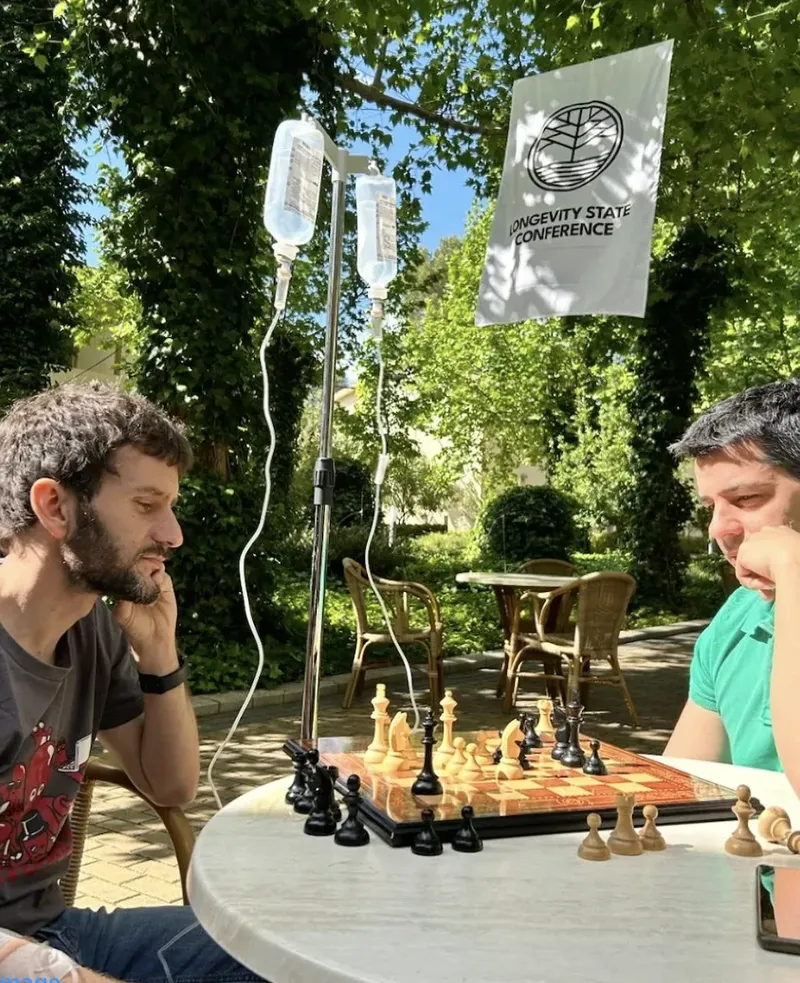
NAD+ is real biology, but an IV drip is not the same as an oral precursor or a promise of rejuvenation. This guide separates all three.
NAD+ has everything an internet trend needs: an essential molecule, a story about aging and an IV bag that looks reassuringly high-tech. The biochemistry is real. The leap from that biochemistry to «more energy», «a sharper brain» or «rejuvenation» is where the trouble begins.
To assess NAD+ therapy, we need to separate three conversations that are often blended together: what NAD+ does inside cells, what we know about oral precursors such as NR and NMN, and what evidence exists for giving NAD+ intravenously. They are not the same intervention, and one cannot simply borrow the results of another.
The short answer
- NAD+ is essential: it supports energy metabolism, signalling and cellular repair.
- NR and NMN can raise NAD+ metabolites: that effect is better studied than clinical outcomes.
- The drip has a larger evidence gap: human efficacy data for IV NAD+ in wellness or longevity are very limited.
- An IV is not neutral: it adds tolerability, sterility, traceability and venous-access risks.
- A hypothesis is not an indication: fatigue or brain fog needs a broader assessment.
Start with the biology: what NAD+ does
NAD+ stands for nicotinamide adenine dinucleotide. It acts as a coenzyme in reactions that transfer electrons and extract energy from nutrients. It is also a substrate for enzymes involved in DNA repair, stress response and metabolic regulation, including PARPs and sirtuins.
That explains why it attracts aging researchers. It also creates a common logical trap: when a molecule participates in an important process, we assume that adding more will improve it. Bodies do not always work that way. Blood concentration, tissue uptake, metabolism, starting state and disease all change the response.
A small 2012 human tissue study found age-associated changes in NAD+ and oxidative stress. That is a biological observation, not proof that every older adult has an «NAD+ deficiency» or that an infusion corrects aging. There is no accepted clinical NAD+ range that diagnoses fatigue or indicates a drip.
The distinction that clears up most confusion
| Option | What it is | Human evidence | What it does not establish |
|---|---|---|---|
| IV NAD+ | The coenzyme delivered into the bloodstream | Sparse data, mainly tolerability in small settings | Rejuvenation, more energy or superiority to precursors |
| Oral NR | A vitamin B3 precursor | Raises NAD+ metabolites; clinical results vary by population | Benefit for every healthy person or prevention of aging |
| Oral NMN | Another precursor in the synthesis pathway | Raises NAD+ in short studies; mixed functional and metabolic outcomes | That a blood change means better health or longer life |
| Niacinamide and other B3 forms | Related molecules in the same network | Their own uses and pharmacology | Equivalence to NR, NMN or IV NAD+ |
A 2026 PRISMA systematic review found much more human evidence for oral NR and NMN than for intravenous or intramuscular NAD+. Precursors generally raised NAD+ metabolites and were reasonably well tolerated over the short term, but clinical benefits were mixed or inconclusive. It found no eligible outcome trials for IV NAD+ in anti-aging or wellness.
That detail changes the whole discussion. When a provider uses an oral NR study to support an NAD+ drip, it is transferring results across different molecules and routes. It is rather like using evidence about a food to market an injection of one component.
What precursor trials have shown
In a randomised trial of healthy middle-aged and older adults, NR raised NAD+ and was well tolerated during the study. In 2026, a comparative study in healthy adults showed that NR and NMN increased circulating NAD+, while each precursor produced a different metabolic signature. These findings show that the pathway responds, not that lifespan changes.
Clinical results depend heavily on the group. In the NICE trial, people with peripheral artery disease who received NR improved a walking-distance measure compared with placebo. That is an interesting signal in a specific disease and outcome. It does not prove that a healthy person will run faster, recover better or live longer.
A trial in older adults with mild cognitive impairment found that NR raised blood NAD+, but did not improve cognition over ten weeks. It neatly illustrates the difference between moving the marker and improving what matters.
What about intravenous NAD+?
The map is much emptier here. A 2026 retrospective study compared IV NAD+ and IV NR in a real-world setting over four days. It reported more gastrointestinal symptoms, increased heart rate and chest pressure during NAD+ administration, as well as slower infusions. Short-term laboratory tests did not reveal major harm signals.
That design can inform tolerability. It cannot tell us whether NAD+ improves energy, biological aging or function because it was not a randomised efficacy trial with suitable outcomes. Nor does it establish one universal dose, speed or number of sessions.
Direct bloodstream delivery sounds like «100% bioavailability», but that phrase does not answer the important questions. We still need to know how the molecule is metabolised, what reaches each tissue, how long it lasts and whether any change produces a clinical benefit that outweighs risk and cost.
Safety does not stop at the ingredient
Nausea, abdominal discomfort, flushing, palpitations and chest pressure have been described during infusion, often in relation to speed. Chest symptoms or breathing difficulty should never be normalised as proof the product is «working». They call for the infusion to be stopped or adjusted and the person assessed.
Then there are the risks of any IV route: infection, phlebitis, reactions, concentration error and contamination. The US FDA has warned compounders about ingredients unsuitable for sterile products and received reports compatible with excessive endotoxins in NAD+ preparations.
«Pure NAD+» is therefore not enough information. A responsible provider should explain source, lot, preparation conditions, injectable grade, responsible staff, monitoring and response to a reaction. Chemical purity and sterility are separate questions.
Fatigue, brain fog and recovery: investigate before attributing
Fatigue can result from insufficient sleep, sleep apnoea, anaemia, thyroid disease, infection, depression, anxiety, low energy availability, overtraining, medication, cardiopulmonary disease and many other causes. Jumping straight to «low NAD+» may delay an explanation we can actually treat.
A proportionate assessment starts with history, symptoms and examination, adding tests only when they change decisions. This guide to useful biomarkers explains how to avoid panels without a question. If the discussion centres on mitochondria, our guide to mitochondrial dysfunction separates a biological pathway from a clinical diagnosis.
Even if someone chooses to try an intervention after reviewing alternatives, it helps to define one outcome beforehand: a fatigue scale, a functional test or a meaningful symptom. «Feeling different» for a day or two is highly vulnerable to expectation, hydration, rest and regression to the mean.
NAD+ and cancer: no shortcut to an answer
NAD+ supports repair and survival in normal cells. Tumour cells also use NAD+ pathways to sustain metabolism and repair. That does not show that a supplement or drip causes cancer, but it does prevent a universal promise of oncology safety.
With active cancer, treatment in progress or a recent history, the decision should be coordinated with oncology. Caution comes from insufficient clinical evidence and biology that may behave differently across tumour and treatment types, not from an invented blanket contraindication list.
How to read an NAD+ offer without getting lost
- Identify the molecule: NAD+, NR, NMN, NADH and niacinamide are not synonyms.
- Identify the route: do not accept oral evidence as automatic proof of an infusion.
- Ask for the outcome: «energy», «detox» and «anti-aging» are not defined endpoints.
- Review alternatives: ask which common causes and better-supported options were considered.
- Require safety details: sterile preparation, traceability, supervision and response to adverse events.
- Agree a stopping rule: if the metric does not improve in the defined period, do not turn uncertainty into a subscription.
The useful question is not «does NAD+ work?». It is more precise: «which compound, in which person, by which route, for which outcome and compared with which alternative?». When an offer cannot withstand those questions, science is usually being used as scenery.
This is the same filter we apply to other biohacking proposals: a molecular explanation may be accurate while the clinical product remains unproven.
Frequently asked questions
What is NAD+?
NAD+ is a coenzyme involved in energy production, cellular signalling and DNA repair. Being essential to cells does not prove that giving it to a healthy person produces rejuvenation.
Are NAD+, NR and NMN the same thing?
No. NAD+ is the coenzyme; NR and NMN are precursors the body can use to make it. Their routes, studied doses and clinical evidence differ and should not be combined into one promise.
Does IV NAD+ have proven benefits?
There are still no robust trials showing that IV NAD+ improves longevity, energy or function in healthy people. Published data mainly describe tolerability and do not establish anti-aging efficacy.
Do NR or NMN raise NAD+?
Several trials show that NR and NMN can raise blood NAD+ metabolites over the short term. Effects on function, metabolism or cognition are mixed, and moving a biomarker is not the same as improving health.
What are the risks of an NAD+ drip?
It can cause nausea, abdominal discomfort, flushing, heart-rate changes or chest pressure during infusion. The intravenous route also adds risks from infection, phlebitis, preparation and contamination.
Does NAD+ treat fatigue?
It is not a proven treatment for non-specific fatigue. Sleep, anaemia, thyroid disease, mental health, infection, medication, nutrition and other common causes should be reviewed first because they change management.
Is NAD+ safe after cancer?
There is no universal answer. NAD+ metabolism supports healthy and tumour cells, so active cancer, oncology treatment or a recent cancer history calls for discussion with the oncology team before use.
What should I ask before paying for NAD+ therapy?
Ask which molecule and route are offered, which evidence applies to that exact route, who prepares the product, which risks are reviewed, which outcome will be measured and when treatment stops if it does not help.
Sources
- Gallagher C, Emmanuel OO. Systematic review of NAD+ for anti-aging and wellness. 2026.
- Massudi H et al. Age-associated changes in NAD+ and oxidative stress. 2012.
- Martens CR et al. Trial of nicotinamide riboside in adults. 2018.
- McDermott MM et al. NICE trial of NR in peripheral artery disease. 2024.
- Orr ME et al. NR trial in mild cognitive impairment. 2024.
- Jensen J et al. Comparison of three NAD+ boosters. 2026.
- Frontiers in Aging. Retrospective tolerability pilot of IV NAD+ and IV NR. 2026.
- US Food and Drug Administration. Warning on ingredients for sterile compounding. 2024.
This article is informational and does not replace medical assessment. Intravenous products require appropriate prescribing, preparation, consent and clinical supervision.
Related articles

Sirtuins: What They Are and Why Activating a Pathway Is Not Longevity
SIRT1 to SIRT7 connect metabolism, repair and stress responses. The biology is fascinating; a promise of longer human life remains unproven.
Plasmapheresis: What a Session Involves and Which Risks Matter
What happens during plasmapheresis, why techniques differ and which questions to ask about indication, replacement fluid, risks and cost.

Hyperbaric Oxygen: Evidence-Based Uses, Risks and Limits
Hyperbaric oxygen treats specific medical problems, but it has not been shown to extend life. We separate accepted indications, anti-aging studies and marketing.

Metformin and Longevity: What to Know Before Asking for It
Metformin treats type 2 diabetes and may prevent it in selected high-risk people, but it has not been shown to slow aging in healthy adults. How to decide without copying an online dose.