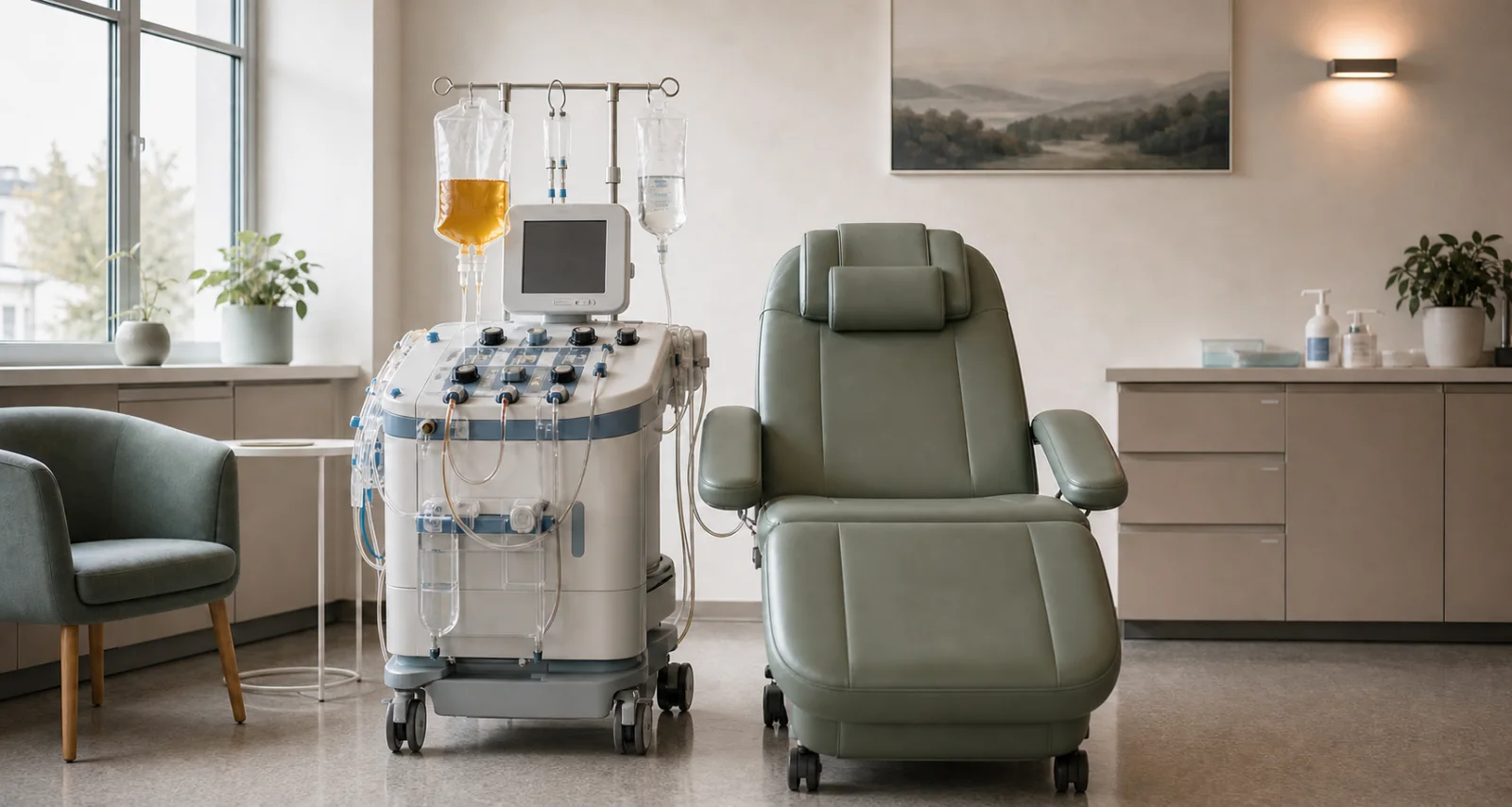
What happens during plasmapheresis, why techniques differ and which questions to ask about indication, replacement fluid, risks and cost.
«Plasmapheresis» sounds like one technique, but it actually names a family of procedures. That difference matters: donating plasma, filtering selected molecules and removing plasma for replacement do not pursue the same goal, always use the same circuit or share exactly the same risks.
If you are considering plasmapheresis, a responsible explanation does not begin with price or a promise to «clean the blood». It begins with three questions: which clinical problem is being treated, which exact procedure is proposed and which outcome would justify repeating it.
What matters before you read on
- It is a medical procedure: blood temporarily travels outside the body so plasma can be separated.
- Indication comes first: plasma exchange is accepted treatment for specific diseases, not a general detox.
- Replacement matters: albumin, plasma and other strategies change effects and risks.
- Longevity remains research: moving biomarkers does not prove rejuvenation or a longer life.
- Cost needs context: technique, access, laboratory work, staff and follow-up make up the real quote.
Plasmapheresis, TPE and filtration: sorting out the words
Plasmapheresis is the general term for separating plasma and blood cells. In donation, some plasma is collected and the cells return to the donor. In therapeutic plasma exchange, or TPE, a clinically meaningful amount of plasma is removed and replaced with albumin, donor plasma or another fluid selected for the indication.
Filtration and adsorption techniques may instead retain selected molecules and return part of the plasma. Centrifugation and membrane separation are different methods. A statement such as «we offer plasmapheresis» is therefore incomplete. Ask what leaves, what returns and what replacement is used.
Dialysis is not the same either. Although both use extracorporeal circuits, dialysis focuses on water, electrolytes and small molecules, particularly when kidneys cannot remove them. TPE modifies the plasma compartment and can remove antibodies, immune complexes and other large proteins.
Our guide to therapeutic plasma exchange and evidence explores the difference between established indications and longevity research.
When it is an accepted treatment
The American Society for Apheresis publishes guidance that classifies diseases according to the role of apheresis and the quality of evidence. In selected neurological, haematological, renal or autoimmune conditions, TPE can be first-line treatment or an accepted component of care. In others it is second-line, and for some it is discouraged or investigational.
A category cannot be carried from one disease to another. The fact that TPE can remove a pathogenic autoantibody does not show benefit in a healthy person. Nor does it mean every «filtration» technique reproduces the effects of the TPE protocol that was studied.
Longevity is not an established anti-aging indication. Any use in that setting should be described as experimental, with uncertainty, consent and a measurable research question. Presenting it as routine preventive maintenance would run ahead of the evidence.
What happens during a session, without turning this into a manual
The protocol changes by technique and disease, but the broad sequence looks like this:
- Pre-assessment: diagnosis, symptoms, vascular access, medication, allergies and relevant coagulation, protein and electrolyte results are reviewed.
- Vascular access: a peripheral vein or catheter may be used depending on flow, duration, vascular status and clinical plan. Their risks differ.
- Separation: blood enters a closed circuit that separates plasma and cells by centrifugation or membrane.
- Removal, filtration or replacement: the prescribed technique is completed and cells return with the selected fluid.
- Monitoring: symptoms, vital signs, circuit and tolerance are watched. Some tests are repeated when the indication calls for them.
- Observation and plan: access, stability and warning signs are reviewed before discharge.
There is no universal duration. Preparation, access, processed volume, technique and tolerance can make the whole visit last several hours. A centre should explain its protocol without marketing speed as a proxy for quality.
What it can feel like
Needle placement is often the most uncomfortable part. During circulation, some people feel cold, tired, dizzy or nauseated, or notice tingling around the mouth and fingers. Tingling can occur because citrate anticoagulant temporarily binds calcium.
Symptoms should not be minimised. The team may adjust the procedure, treat the cause or stop. Chest pain, breathing difficulty, fainting, allergic symptoms or rapid deterioration need immediate assessment. «Pushing through to finish the volume» is not a mark of quality.
Risks depend on the person, technique and replacement
| Area | What may happen | What changes risk |
|---|---|---|
| Circulation and volume | Dizziness, low blood pressure, weakness | Baseline state, replacement, speed, medication |
| Citrate and electrolytes | Tingling, cramps; rarely more serious symptoms | Anticoagulant, metabolism, repeated sessions |
| Replacement | Allergic or transfusion reaction | Use of plasma, history, indication |
| Clotting and proteins | Bleeding, lower fibrinogen or immunoglobulins | Volume, repetition, disease, anticoagulants |
| Vascular access | Bruising, infection, thrombosis or injury | Peripheral or central route, duration, care |
| Medication | The procedure may remove some drugs or alter their effect | Distribution volume, protein binding and timing |
A prospective study of 1,727 procedures found most reactions were manageable, but the profile changed with replacement fluid and access. Cohort averages do not predict individual risk or justify reassuring commercial percentages.
Medication review is particularly important. Nothing should be stopped because of an internet guide. The responsible team decides whether a drug interacts with the procedure, may be removed by the circuit or needs different timing.
What evidence supports «rejuvenation»?
The modern story began with experiments comparing young and old circulatory environments. In 2020, a mouse study found that diluting old plasma with saline and albumin changed signals in muscle, liver and brain. This was preclinical research. Animals, protocol and outcomes do not support a human promise.
In 2022, a small plasma-dilution clinical study reported changes in biological clocks and other biomarkers. In 2025, a single-blind randomised trial with 42 participants found multi-omic and biological-age changes, particularly in one arm that added immunoglobulin. Size, follow-up and multiple measurements call for replication.
Also in 2025, a trial of repeated plasmapheresis in healthy donors found no epigenetic rejuvenation. This cannot be settled by choosing the result we prefer: techniques, replacement, population and outcomes differed. That is precisely why «plasmapheresis» is not one intervention.
Until independent studies demonstrate clinical benefit, the limit should be explicit: we do not know whether these biomarker changes improve function, reduce disease or extend life. A clock or protein is a follow-up hypothesis, not a fountain of youth.
Cost: why a single number misleads
Cost may include clinical assessment, single-use materials, replacement fluid, laboratory work, vascular access, medication, specialised staff, observation and follow-up. A course is not comparable to one session, and donor plasma creates different logistics from albumin.
Before comparing quotes, request an itemised plan and written indication. If the explanation only mentions «toxins», «inflammation» or «biological age», the essential pieces are missing: what will be removed, which outcome will be measured and which less invasive alternative has been considered.
Eight questions a serious proposal should answer
- What is the diagnosis or specific hypothesis?
- Is this donation plasmapheresis, TPE, filtration or adsorption?
- What volume and replacement does the protocol use, and why?
- Which evidence applies to my indication and this exact technique?
- Which access is planned and who manages complications?
- How will medication, coagulation, calcium and proteins be reviewed?
- Which clinical outcome or interpretable biomarker will be measured?
- When will the course stop for lack of benefit or unacceptable risk?
For questions about the centre, team and follow-up, this guide to choosing a longevity clinic offers criteria that matter more than a technology list.
Frequently asked questions
What is plasmapheresis?
It is a procedure that separates plasma from blood cells through an extracorporeal circuit. Depending on the technique, plasma is collected, filtered or removed and replaced with a selected fluid.
Are plasmapheresis and plasma exchange the same?
Not exactly. Plasmapheresis is the broad term for separating plasma; therapeutic plasma exchange removes a clinically relevant volume and replaces it. Indication, equipment and risks depend on the exact procedure.
How long does a plasmapheresis session take?
It often takes several hours across preparation, vascular access, processing and observation, but timing changes with technique, volume, access and tolerance. The centre should explain its exact protocol.
Does plasmapheresis hurt?
The main discomfort is usually vascular-access placement. Cold, tingling, dizziness or nausea can occur during treatment; severe pain, breathing difficulty or progressive symptoms need immediate assessment.
What are the risks of plasmapheresis?
Risks include low blood pressure, citrate-related calcium changes, bleeding, reactions to replacement fluid, access infection or thrombosis, and changes in medication or plasma proteins. The profile depends on technique and patient.
Does plasmapheresis reverse aging?
Clinical rejuvenation and longer life have not been demonstrated. Small studies found biomarker changes, while another trial in healthy donors found no epigenetic rejuvenation. Anti-aging use remains experimental.
How much does plasmapheresis cost?
There is no universal clinical price. It depends on indication, technique, replacement fluid, access, laboratory work, staff, session count and follow-up. A useful quote should itemise all of these, not just the machine.
What should I ask before agreeing to plasmapheresis?
Ask about the indication, exact technique and replacement fluid, supporting evidence, clinical supervision, medication and adverse-event management, the outcome being measured and the stopping rule.
Sources
- American Society for Apheresis. Guidelines on therapeutic apheresis in clinical practice. 2023.
- Cervantes CE et al. Therapeutic Plasma Exchange: Core Curriculum. 2023.
- Shemin D et al. Prospective complication study across 1,727 procedures. 2007.
- Mehdipour M et al. Old-plasma dilution in an animal model. 2020.
- Kim D et al. Clinical study of plasma dilution and biological age. 2022.
- Fuentealba M et al. Randomised TPE trial and biological-age biomarkers. 2025.
- Borsky P et al. Plasmapheresis trial and biomarkers of aging. 2025.
- Hafer C et al. Membrane versus centrifuge TPE comparison. 2016.
This article is informational and does not replace medical assessment. Therapeutic apheresis requires an indication, a trained team and clinical supervision.
Related articles

Hyperbaric Oxygen: Evidence-Based Uses, Risks and Limits
Hyperbaric oxygen treats specific medical problems, but it has not been shown to extend life. We separate accepted indications, anti-aging studies and marketing.
Therapeutic Plasma Exchange: Proven Medicine or Anti-Aging Promise?
TPE can be lifesaving in specific indications. For rejuvenation or microplastics, the evidence tells a different story. Here is how to separate them.
NAD+ Therapy: What We Know About IV Drips, NR and NMN
NAD+ is real biology, but an IV drip is not the same as an oral precursor or a promise of rejuvenation. This guide separates all three.

Metformin and Longevity: What to Know Before Asking for It
Metformin treats type 2 diabetes and may prevent it in selected high-risk people, but it has not been shown to slow aging in healthy adults. How to decide without copying an online dose.