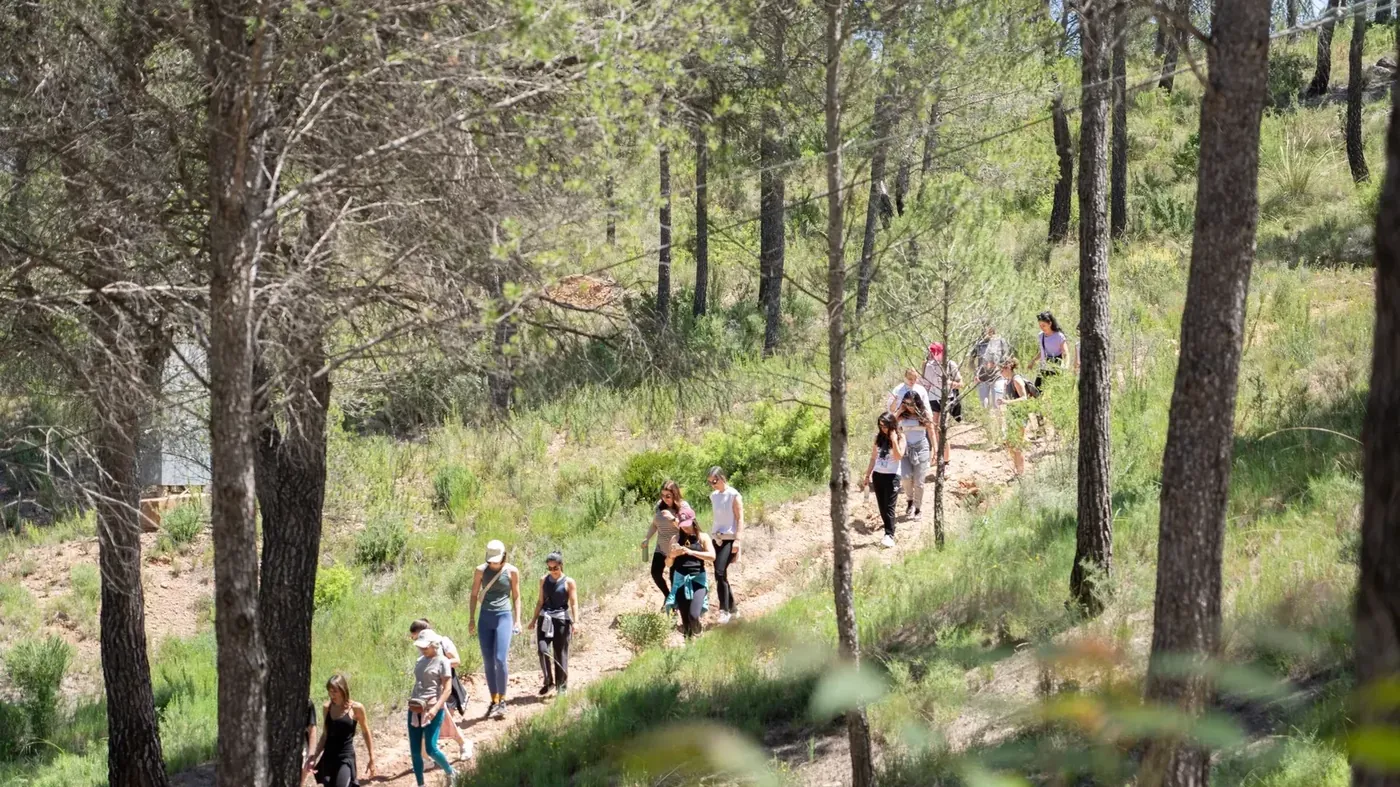
Nature may offer a useful pause, but it is not a cure for anxiety. What studies show, what they cannot prove and how to try it without creating another obligation.
Going among trees may not change the problem, but it can change the next ten minutes. Noise drops, breathing has room and the mind slows a little. That benefit can be real without turning a forest into a clinic or a cure for anxiety.
Forest bathing, or shinrin-yoku, describes slow, sensory time in nature. It may involve walking, sitting, watching light and shapes or listening. There is no single technique, and it needs no mysticism, equipment or perfect trail.
The essentials
- The signal is promising: reviews find average improvements in wellbeing and stress across very different studies.
- A marker is not the outcome: cortisol, pulse or blood pressure may change without proving durable clinical improvement.
- There is no universal dose: 120 minutes a week is a population association, not a prescription.
- Nature can be nearby: parks, gardens, urban trees and water may count.
- The clinical boundary matters: severe anxiety, depression or impaired function need professional care.
What the reviews show
A review of nature prescriptions included 92 studies and found favourable signals for blood pressure, anxiety and depression symptoms and physical activity. Most studies carried moderate or high risk of bias, and interventions mixed walks, guided programmes, gardening and other formats. This supports nature as a health and wellbeing option, but cannot show that trees were the decisive component.
A review of randomized green-prescription trials also reported positive findings across several areas, with different populations, durations and measures. Another review of forest bathing found average psychological wellbeing improvements. Heterogeneity prevents a promise of the same response or schedule for everyone.
| Outcome | Cautious reading | What it cannot show |
|---|---|---|
| Stress or mood after a session | Brief, useful relief may occur | Treatment of an anxiety disorder |
| Average blood pressure | Some studies report small changes | Individual control or replacement of treatment |
| Salivary cortisol | It may vary with timing and context | Stress diagnosis or hormonal balance |
| More activity | An enjoyable setting may support movement | That every nature visit is sufficient exercise |
The 120 minutes is not a prescription
An observational study found that people reporting at least 120 minutes a week in nature were more likely to report good health and wellbeing. It did not randomly assign a dose. People with better health, more time, access or safer neighbourhoods may also go outside more often.
Use the number as an invitation, not an exam. Ten accessible minutes may be more useful than a perfect target that never happens. We also do not know whether one long visit, several pauses or a group works best for you. Fit and experience matter more than completing a quota.
Forest, park or water?
You do not need to travel. A park, tree-lined street, garden or waterside space may offer daylight, screen distance, movement and a cognitive pause. A review of green and blue spaces in urban youth suggests possible mood and anxiety benefits across varied designs and outcomes.
Safety, access and preference change the experience. Sitting may work for limited mobility. Walking with company may reduce isolation. If silence increases anxiety, a familiar route or quiet conversation may fit better.
When water is part of a therapeutic stay, it helps to separate nature, rest, heat, movement and mineralisation. We cover that in the guide to mineral-water balneotherapy.
Our guide to natural light and circadian health explains how going outside also changes light exposure. Not every effect can be attributed to the forest.
A simple practice that does not become another task
- Choose a viable place: safe, accessible and pleasant enough to revisit.
- Lower the target: you need no distance, speed or breathing technique.
- Leave sensory room: look far away, listen and notice the ground without forcing calm.
- Notice the exit: did tension, mood or ability to return to the day change?
The phone may stay away when safe, but this is not a moral rule. It may provide navigation or company. The aim is not doing forest bathing correctly. It is making a repeatable pause.
Measuring without turning rest into a laboratory
You do not need a cortisol test. One sample depends on time, collection and context and cannot diagnose chronic stress alone. HRV and resting heart rate may show trends but also change with sleep, exercise, alcohol, infection and algorithms.
The useful question is often ordinary: am I sleeping, functioning or relating a little better? If you already monitor blood pressure for a clinical reason, use comparable technique and share relevant trends with your clinician. Do not add measurements simply to prove a walk deserves time.
Our guide to recovery and fatigue shows how to use several signals without searching for one magic marker.
Nature and anxiety are not the same as treatment
WHO and NHS describe anxiety disorders as conditions that may cause intense fear, physical symptoms and impaired daily life, with psychological and medical treatments available. Nature may support activity, connection and self-care; it does not replace assessment or indicated treatment.
Seek help for panic attacks, depression, thoughts of self-harm, alcohol or medication used to cope, or inability to work or connect. With immediate risk, use local emergency or crisis services. Our guide to health pillars may organize habits but cannot replace mental healthcare.
Frequently asked questions
What is forest bathing?
It is a slow, sensory way of spending time in nature without a mandatory fitness goal. It may involve walking, sitting, observing or listening. It is not one standardized clinical technique and does not require a perfect forest.
Does forest bathing reduce stress?
Studies suggest average short-term improvements in stress, mood and some markers, but interventions and quality vary. It may be a useful wellbeing practice; it cannot guarantee the same effect for every person.
Can it treat an anxiety disorder?
It should not be presented as a substitute for psychotherapy, medical care or indicated medication. It may accompany care and daily activity, but a disorder causing functional impairment needs professional assessment.
How much time do I need in nature?
There is no universal clinical dose. The 120-minute weekly finding comes from a population association, not a prescription. Start with an accessible amount and notice whether the habit fits and supports wellbeing.
Does it have to be a forest?
No. A park, garden, urban trees or waterside space may offer a pause. Safety, access, personal preference and the ability to slow down matter more than perfect scenery.
Is walking better than sitting?
There is no universal answer. Walking adds physical activity; sitting may be more accessible or calming. Choose according to mobility, fatigue, safety and what makes it easier to be present without performance pressure.
Should I measure cortisol, HRV or blood pressure?
Not to justify an everyday practice. One cortisol or HRV reading does not diagnose stress. Blood pressure is monitored when indicated and with proper technique; wellbeing and function matter too.
When should I not wait for a walk to help?
Do not wait with thoughts of self-harm, severe panic, inability to function, major depression, worrying physical symptoms or substance use to cope. Seek professional or urgent help according to the situation.
Sources
- Nguyen PY et al. Nature prescriptions and cardiometabolic and mental health: systematic review. Lancet Planet Health. 2023. Europe PMC.
- Adewuyi FA et al. Health effects of green prescription: systematic review of randomized trials. Environ Res. 2023. Europe PMC.
- Siah CJR et al. Forest bathing and psychological wellbeing: systematic review and meta-analysis. Int J Ment Health Nurs. 2023. Europe PMC.
- Qiu Q et al. Forest therapy, blood pressure and salivary cortisol: meta-analysis. Int J Environ Res Public Health. 2022. Europe PMC.
- White MP et al. Spending at least 120 minutes a week in nature and self-reported health and wellbeing. Sci Rep. 2019. Europe PMC.
- Bray I et al. Green and blue spaces and anxiety and depression in urban youth: systematic review. Environ Res. 2022. Europe PMC.
- World Health Organization. Anxiety disorders. WHO.
- NHS. Generalised anxiety disorder. NHS.
Method note: editorial and source review completed on 30 August 2026. Wellbeing, association, acute changes and clinical treatment are kept separate; no dose, biomarker or programme is presented as universal.
Related articles

Mineral-Water Balneotherapy: Benefits, Evidence and Limits
A thermal bath may ease symptoms and help you move, but it does not rejuvenate on command. We review pain, stress, sleep, inflammation and multi-day dose.
What Semen Can Tell You About a Man's Health
A semen analysis may open questions about testicular health, hormones, medicines and exposures. It is neither a fertility verdict nor a longevity test.
Can a Multivitamin Slow Biological Age? What COSMOS Measured—and What It Did Not
COSMOS found a small shift in two of five epigenetic clocks after two years. Here is the effect size, the limits and when supplementation answers a real nutritional need.
Cardiac Rehabilitation: Much More Than Exercise After a Heart Attack
Cardiac rehabilitation combines prescribed exercise, medication review, nutrition, psychological support and risk-factor control. Learn when to start, how long it lasts and how it changes with age or frailty.