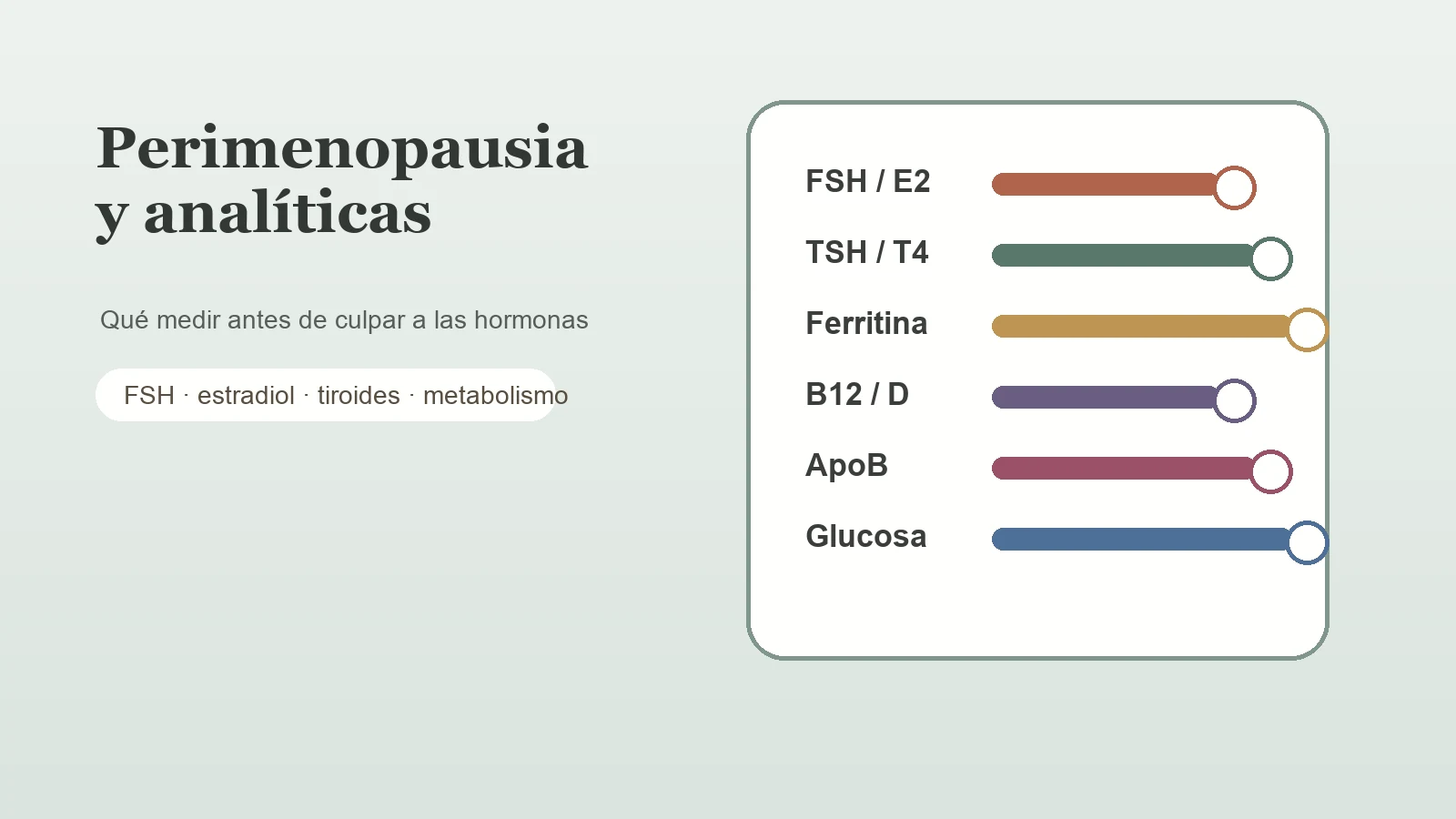
Normal blood work does not invalidate your symptoms, and one FSH result does not confirm perimenopause. Which tests may help with a clinical question.
It can be frustrating to leave a consultation with very real symptoms and “normal” blood work. The opposite can also happen: an FSH result appears in red and suddenly that number seems to explain everything. In perimenopause, neither reading is enough on its own.
Ovarian hormones fluctuate, and the cycle starts changing before it stops. A useful assessment therefore begins with a conversation: age, menstrual pattern, hot flashes, sleep, bleeding, medication, pregnancy possibility and other symptoms. Then you decide whether a test can answer a specific question. More tubes do not always create more clarity.
The short answer
- Over 45 with a typical presentation, diagnosis is usually clinical.
- FSH and estradiol fluctuate: one number cannot confirm or exclude the transition.
- Before 45, the approach may change: an early or atypical presentation deserves more investigation.
- Tests follow symptoms: bleeding, fatigue, thyroid clues and vascular risk raise different questions.
- There is no universal panel: each result should be capable of changing a decision.
Why blood work cannot “see” all of perimenopause
The STRAW+10 framework organizes reproductive aging mainly through cycle changes. FSH can offer supporting information, but it does not act like an on-off switch. Ovulatory and anovulatory cycles can alternate, while estradiol and FSH vary substantially.
The 2025 European Society of Endocrinology clinical guideline advises against routine biochemical testing to identify perimenopause or menopause in women over 45 with compatible symptoms. Diagnosis rests on the clinical history. Guidelines use “women” because that is the population studied most often; some trans and non-binary people with ovaries also go through this transition and need adapted assessment.
This does not mean “never measure anything”. It means tests should look for something that could change care, not prove that your symptoms exist.
FSH, estradiol, AMH and progesterone: one question for each test
| Test | What it may add | What it cannot solve alone |
|---|---|---|
| FSH | Support when the presentation is early, atypical or uncertain. | Confirm or exclude typical perimenopause from one sample. |
| Estradiol | Context in specific endocrine or reproductive decisions. | Summarize weeks of hormonal variation in one number. |
| AMH | Ovarian-reserve information in some fertility settings. | Date menopause or explain every symptom. |
| Progesterone | Help answer specific ovulation questions when timed meaningfully. | Interpret irregular cycles from a random value. |
There is no FSH range to turn into a home diagnosis. The laboratory, cycle phase, hormonal contraception and other treatment change interpretation. If you are over 45 with changing cycles and typical symptoms, “normal” FSH does not invalidate the picture. If changes begin before 45, especially before 40, investigation may differ because early menopause or premature ovarian insufficiency has implications for bone, fertility and general health.
Start with the question, not the panel
| Situation | What needs clarifying | Tests that might help |
|---|---|---|
| Typical changes after 45 | Cycle pattern, hot flashes, sleep, urogenital symptoms and preferences. | Often no hormone test for confirmation; other tests only by symptom or risk. |
| Symptoms from 40 to 45 | Early menopause, pregnancy, thyroid, medication and other causes. | FSH or other tests according to history and clinical guidance. |
| Symptoms before 40 | Possible premature ovarian insufficiency and alternative diagnoses. | Targeted clinical and hormonal evaluation, not self-interpretation. |
| Cycle hidden by hormones or surgery | Symptoms, current treatment and which organs remain. | Selected tests only if they can resolve meaningful uncertainty. |
Heavy bleeding is not just “a hormone”
Cycles may become irregular in perimenopause, but not all bleeding should be normalized. Amount, duration, bleeding between periods, pain, pregnancy possibility, medication and history guide assessment. The FIGO system reminds us that abnormal uterine bleeding has structural and non-structural causes; blood work cannot replace gynecological evaluation.
If pregnancy is possible, a test may form part of the work-up. A blood count and ferritin may help when bleeding raises concern about anemia or iron deficiency. Depending on age and pattern, examination, ultrasound or endometrial assessment may be needed. FSH cannot make that decision.
Seek urgent care if you repeatedly soak protection, feel faint, pass out, become short of breath, have severe pain or suspect pregnancy with bleeding. Any bleeding after twelve months without a period deserves assessment.
Fatigue, hair loss or brain fog: investigate without firing at everything
Fatigue may overlap with broken sleep, hot flashes, anxiety, bleeding, thyroid disease, iron deficiency, low B12, medication effects or many other factors. The combination of symptoms and history determines what to check.
- Blood count and ferritin: particularly with heavy bleeding, breathlessness, palpitations or low dietary iron.
- Thyroid function: when the pattern includes cold intolerance, constipation, weight change, neck enlargement, relevant medication or history.
- B12: when diet, digestive surgery, metformin, acid-reducing medication, anemia or neurological symptoms make it plausible.
- Other tests: only when a specific clinical clue justifies them.
There is no compulsory brain-fog package. Our guide to perimenopause brain fog explains how to connect sleep, hot flashes, mood, bleeding and function without turning every lapse into dementia.
Cardiometabolic and bone health: normal prevention, not a biomarker showroom
The menopause transition overlaps with changes in lipids, blood pressure, fat distribution and cardiovascular risk. It is a good moment to make sure routine prevention is current: blood pressure, smoking, activity, family history, weight or waist when informative, and diabetes and lipid screening according to age and risk.
This does not make fasting insulin, HOMA-IR, hsCRP, ApoB, cortisol, vitamin D or an inflammatory panel mandatory for everyone with hot flashes. Some may be useful for a particular risk or question; ordering them without a plan may find variation that does not explain the symptom.
Bone health follows the same principle. Bone-density testing and checks for vitamin D, calcium or secondary causes depend on age, fractures, medication, low weight, disease and other risk factors. Perimenopause alone does not require every test. If weight or waist change is the main concern, this guide to menopause and body change helps separate fat, muscle, sleep and habits.
Before hormone therapy: history first
Hormone therapy is considered through symptoms, expected benefits, risks and preferences. There is no universal battery everyone must pass. Clinical history, blood pressure, bleeding pattern, medication, contraindications and age-appropriate screening usually guide the start. Tests are added when a particular uncertainty could change the route, dose or indication.
High FSH does not mandate treatment, and normal FSH does not prevent a treatment conversation when the picture is typical. Our guide to menopause hormone therapy explains what it can improve, what it cannot promise and how the decision is individualized.
How to prepare for a consultation that produces answers
- Bring the pattern: period dates, bleeding amount, hot flashes, sleep and dominant symptoms.
- List medication and supplements: include contraception, hormones and recent changes.
- Describe the impact: which task, rest, relationship or work demand is changing.
- Ask about the decision: “what would change if this test is normal or abnormal?”.
- Agree on follow-up: what to watch, when to review and which signs bring care forward.
Good blood work is not the panel with the most boxes. It prevents an error, confirms a useful hypothesis or opens a treatment that genuinely makes sense for you.
Frequently asked questions
Is there a blood test that confirms perimenopause?
Usually not. In people over 45 with typical symptoms and cycle changes, assessment is generally clinical. A single FSH or estradiol result can fluctuate and does not confirm or exclude the transition by itself.
What FSH level means menopause?
No isolated value should be interpreted without age, menstrual pattern, medication and context. Ranges vary and FSH fluctuates. If testing is useful, a clinician should decide how the result will be used.
When can FSH testing be useful?
It may help when symptoms or menstrual changes begin between 40 and 45, before 40 or in an atypical situation. Hormonal contraception and other treatments can make interpretation difficult.
Do I need estradiol, AMH or progesterone?
Not routinely to identify perimenopause in someone over 45 with a typical presentation. They have specific uses in fertility, ovarian insufficiency or other decisions, but they are not a mandatory panel.
What is checked for heavy bleeding?
Bleeding needs a gynecological history and, when appropriate, examination or imaging. Pregnancy is excluded when possible; a blood count and ferritin may assess anemia or iron deficiency. Urgent bleeding should not wait for scheduled blood work.
Which tests may help with fatigue or brain fog?
It depends on symptoms. Bleeding, diet, medication, sleep and history may point to a blood count, ferritin, thyroid function or B12. Not everyone needs every test, and normal results do not invalidate the experience.
Do I need a special cardiometabolic panel?
The transition is a good time to review prevention, but tests should follow age, blood pressure, history and individual risk. Glucose or HbA1c and lipids may be appropriate; insulin, HOMA-IR, hsCRP or ApoB are not a mandatory panel for everyone.
Which tests are needed before hormone therapy?
There is no universal battery. The decision starts with symptoms, history, blood pressure, contraindications and age-appropriate screening. Tests are added only when a clinical question or risk factor could change treatment.
Sources
- Gambacciani M et al. European Society of Endocrinology clinical practice guideline for evaluation and management of menopause and the perimenopause. Eur J Endocrinol. 2025. Europe PMC.
- Harlow SD et al. Executive summary of STRAW+10. Menopause. 2012. Europe PMC.
- Stevenson JC et al. Diagnosis of perimenopause and menopause. Post Reprod Health. 2016. Europe PMC.
- Jane FM, Davis SR. A practitioner's toolkit for managing the menopause. Climacteric. 2014. Europe PMC.
- The 2022 Hormone Therapy Position Statement of The North American Menopause Society. Menopause. 2022. Europe PMC.
- Stuenkel CA et al. Treatment of symptoms of the menopause: an Endocrine Society clinical practice guideline. J Clin Endocrinol Metab. 2015. Europe PMC.
- El Khoudary SR et al. Menopause transition and cardiovascular disease risk: AHA scientific statement. Circulation. 2020. Europe PMC.
- Munro MG et al. FIGO classification system for causes of abnormal uterine bleeding. Int J Gynaecol Obstet. 2011. Europe PMC.
Method note: editorial and source review completed on 30 August 2026. Population guidance is separated from individual assessment, and hormone ranges, panels or treatments are not presented for self-diagnosis.
Related articles

Perimenopause: Real Symptoms, Red Flags and How to Care for Yourself
A warm, evidence-based guide to cycle changes, hot flushes, sleep and mood, with clear advice on when to seek care and which treatments may help.

DunedinPACE and aging speed: how to read a 0.57x result
A 0.57x result does not mean living almost twice as long. Here is what DunedinPACE measures, why it can change and when repeating it may be useful.
Recovery Biomarkers for Athletes: What They Add and When to Stop Measuring
A watch or blood test can clarify a question, but neither should dictate every session. Read HRV, iron, CK and RED-S without turning normal variation into alarm.

Telomeres: What a Test Measures and What It Really Means
Telomeres protect chromosomes, but a test cannot predict your lifespan. Learn what it measures, why results vary and when testing has clinical value.