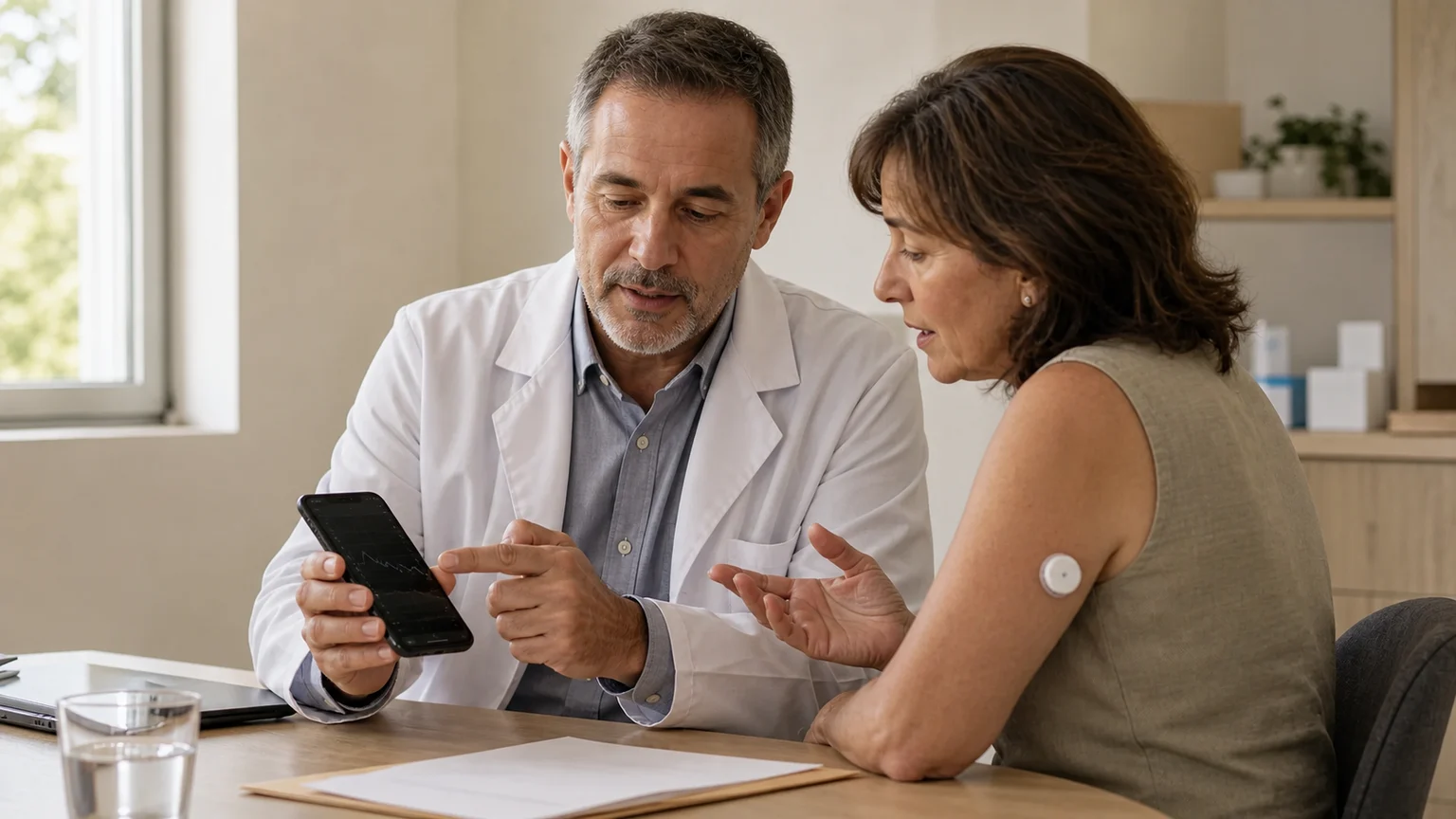
A sensor can help answer one specific question, especially with prediabetes or metabolic risk. It can also turn a normal fluctuation into an unnecessary alarm.
A familiar CGM moment goes like this: someone eats a piece of fruit, sees a rise on the phone and decides they have just discovered a “bad” food. The curve is not a report card. Glucose is supposed to rise after food, and a flatter line does not automatically mean better health.
A continuous glucose monitor can be interesting when it answers one specific question. For example: “I have confirmed prediabetes, does a walk after dinner change a repeatable pattern?”. It is much less useful when the question is “how do I stop my glucose moving at all?”. That second goal is not physiological and can end in anxiety or an unnecessarily narrow diet.
The short answer: it depends who is wearing it and why
| Situation | What CGM may add | What it cannot establish |
|---|---|---|
| Normal glucose, low risk and no symptoms | Curiosity or brief education | That your diet needs changing or that suppressing every rise prevents disease |
| Confirmed prediabetes or high metabolic risk | Short-term biofeedback inside a nutrition, activity and follow-up plan | How much of the result came from the sensor rather than the support around it |
| Symptoms of high or low glucose | Supplementary information when a clinician recommends it | A diagnosis; it must not delay laboratory testing |
| Diagnosed diabetes | A treatment tool with established evidence and disease-specific targets | That clinical use cannot be extrapolated to wellness in healthy people |
The latest review in JAMA Internal Medicine, published in August 2026, offers a sensible rule: CGM should respond to a specific patient problem, not become the default intervention. For prediabetes or obesity, its authors describe the available evidence as limited and indirect.
What the sensor measures, and why it may not match blood glucose
The tiny filament under the skin estimates glucose in interstitial fluid. It is not reading blood directly. When glucose changes quickly, the interstitial value may lag; each device also has an error margin and does not perform identically across the whole range.
- After food or during exercise: the difference from blood glucose may widen because the level is changing quickly.
- When you sleep on the sensor: pressure can create a false dip, often called a compression low.
- When a value makes no sense: confirm an extreme reading that conflicts with symptoms using a validated method before acting.
- Needle-free watches and rings: they are not equivalent. The FDA has warned that it has not authorised devices that measure glucose without piercing the skin.
In the United States, the FDA cleared the first over-the-counter CGM in 2024 for adults who do not use insulin and do not have problematic hypoglycaemia. That means the device met requirements for its intended use. It does not prove that every healthy person benefits from wearing one, and it does not turn the app into a diagnostic test.
One spike is not a diagnosis
Carbohydrate amount and type, fibre, fat, protein, timing, sleep, stress, previous activity, muscle mass, age and the sensor itself all shape the curve. There is no single validated post-meal maximum that can score everyone without diabetes.
Two studies put the numbers into context:
- Among 153 healthy, non-obese participants aged 7 to 80, median time between 70 and 140 mg/dL was 96%. Median time above 140 was 30 minutes per day, and time below 70 was 15 minutes.
- Among 560 normoglycaemic Framingham participants with a mean age of 58.5 years, average time between 70 and 140 mg/dL was 87%. They spent about three hours per day above 140 and just over 15 minutes above 180.
The populations, ages and devices differed. The gap between 96% and 87% does not reveal the “correct” target; it shows why an app should not invent a passing grade. The 70 to 180 mg/dL range was developed for diabetes management, not as a longevity score for healthy adults.
The 2026 ADA diagnostic criteria still use laboratory tests: A1C 5.7% to 6.4%, fasting plasma glucose 100 to 125 mg/dL, or two-hour glucose 140 to 199 mg/dL during a 75-g oral glucose tolerance test. The same Standards consider evidence insufficient to use CGM for screening or diagnosis.
What 2026 research has actually shown
Liao and colleagues included 23 studies, 7 randomised, with 1,074 participants without diabetes. “Without diabetes” covered very different groups: normoglycaemia, prediabetes and even post-bariatric hypoglycaemia. Most interventions added diet, an app, education or coaching to the sensor.
- Mean glucose improved versus control with a moderate standardised effect, but that meta-analysis rested on only two small trials.
- BMI did not fall significantly.
- The glycaemic signal was concentrated in prediabetes; healthy normoglycaemic groups showed no appreciable benefit.
- Most studies followed people for 12 weeks or less.
This supports saying that a sensor may facilitate short-term change inside a programme. It does not show that the patch alone prevents diabetes, cardiovascular events or death.
One trial shows why the whole package matters
Kitazawa and colleagues studied 168 Japanese adults at high risk of diabetes for 12 weeks. The intervention combined an app, coaching and intermittent CGM; control did not receive that package. Time between 70 and 140 mg/dL rose by 31.5 minutes per day in the intervention group and fell by 2.6 minutes in control. The BMI difference favoured the programme by about 0.33 kg/m².
The trial was unblinded, about 80% of participants were men and it could not separate the sensor's contribution from the rest of the programme. It also did not measure new diabetes diagnoses. This is an interesting signal for behavioural support, not proof that buying a CGM produces the result.
If you try one, run a small experiment
There is no validated 14-day protocol for every person without diabetes. A more honest approach is to use one ordinary device cycle, usually 10 to 15 days depending on the model, and decide in advance which question you want to answer.
- Write a question that could change a decision: for example, compare a gentle walk after dinner with remaining seated. “See all my spikes” is not an operational question.
- Observe several ordinary days: log food, sleep, activity, alcohol and symptoms without correcting every rise.
- Change one variable: repeat each condition more than once. The same meal can produce different traces on different days.
- Read the whole pattern: duration, repetition, symptoms and how easy the change feels matter more than the most dramatic peak.
- Use a stopping rule: keep one or two sustainable habits. If the result changes no decision, you do not need another sensor.
Do not compensate for one reading with fasting, exercise or sugar without confirmation. Do not remove fruit, legumes or whole grains after one excursion either. Losing variety, fibre or pleasure to flatten a trace can make the overall diet worse.
When to leave the app and seek an assessment
Marked thirst, frequent urination, unexplained weight loss, blurred vision, vomiting, confusion, fainting or repeated symptoms of low glucose deserve clinical assessment. Persistently high or low patterns that match symptoms also need confirmation. A wellness sensor cannot replace A1C, plasma glucose, an oral glucose tolerance test or clinical judgement.
If you are pregnant, take medication that can alter glucose, have had bariatric surgery or live with a relevant health condition, a consumer experiment is the wrong framework. Review the question and device with the team responsible for your care.
The less visible risk is living by the line
Insertion pain, bruising, irritation, local infection or adhesive allergy are known physical risks. Cost, false alarms and mental load sit alongside them.
In a cross-sectional survey of 56 CGM users with and without diabetes, none using insulin, 68% reported fear of developing diabetes when they saw high values and 89% reported positive diet or activity changes. This was a small, self-selected sample, so those numbers do not estimate what happens to every CGM user. They do show that the same feedback can motivate and distress.
If you check the phone overnight, feel guilty after eating or begin ranking food only by its spike, pause the experiment. People with health anxiety, orthorexia or an eating-disorder history may be better served by conventional tests and professional support.
When the sensor ends, the fundamentals take over
Glucose is one part of the picture, not the whole picture. Breaking up sedentary time and supporting metabolic health, keeping a reasonably regular sleep routine and choosing biomarkers that change decisions usually matter more than watching a trace indefinitely.
CGM can be a short-lived magnifying glass. A useful magnifying glass helps you see something and is then put away; you do not have to live looking through it.
Frequently asked questions
Is a continuous glucose monitor useful without diabetes?
It may add value for one short sensor cycle when someone has confirmed prediabetes, metabolic risk or a question that would genuinely change a decision. In a low-risk, normoglycaemic person without symptoms, routine use has not been shown to prevent disease, cause weight loss or extend life.
Is a glucose spike above 140 mg/dL harmful?
Not necessarily. Studies of people without diabetes found time above 140 mg/dL and even brief periods above 180 mg/dL. Duration, repetition, context and conventional laboratory tests matter; one rise does not diagnose disease or prove harm.
Can a CGM diagnose prediabetes?
No. Diagnostic criteria rely on fasting plasma glucose, A1C or an oral glucose tolerance test. The 2026 ADA Standards consider evidence insufficient to diagnose or screen for prediabetes or diabetes with CGM.
What is a normal CGM range without diabetes?
There is no universally validated healthy target. Two studies found about 96% and 87% of time between 70 and 140 mg/dL in different populations using different devices. These are descriptive references, not pass-or-fail scores.
Why does my CGM show low glucose while I sleep?
It may be real, but sleeping on the sensor can also create a false pressure low. If the fall is abrupt, conflicts with symptoms or resolves after changing position, confirm it with a validated method and seek advice if it recurs.
How long should I wear a CGM to learn something?
There is no universally validated duration for people without diabetes. One device cycle, usually 10 to 15 days depending on the model, is often enough to answer a simple question. If it changes no useful decision, repeating sensors adds more data, not necessarily more health.
Can a CGM help with weight loss?
Not by itself. A 2026 review found no significant BMI reduction, and the latest JAMA review considers evidence in prediabetes or obesity limited and indirect. A sensor may accompany a programme, but it is not the intervention.
What are the risks of wearing a glucose sensor?
Beyond irritation, pain or adhesive reactions, a sensor can create false alarms, cost, compulsive checking and needless food restriction. If it increases guilt, fear or an obsession with flattening the curve, remove it and seek support.
Sources and further reading
- American Diabetes Association Professional Practice Committee. Diagnosis and Classification of Diabetes: Standards of Care in Diabetes 2026. Diabetes Care, 2026.
- Dower J.A. et al. Continuous Glucose Monitoring in Type 2 Diabetes and Beyond: A Review. JAMA Internal Medicine, 2026.
- Liao X. et al. Continuous glucose monitoring in non-diabetic populations: systematic review and meta-analysis. European Journal of Medical Research, 2026.
- Kitazawa M. et al. Lifestyle intervention with smartphone app and isCGM for people at high risk of type 2 diabetes. Journal of Clinical Endocrinology & Metabolism, 2024.
- Spartano N.L. et al. Defining CGM time in range in a community-based cohort without diabetes. Journal of Clinical Endocrinology & Metabolism, 2025.
- Shah V.N. et al. CGM profiles in healthy nondiabetic participants. Journal of Clinical Endocrinology & Metabolism, 2019.
- Richardson K.M. et al. Benefits and psychological burdens of CGM for lifestyle change. Obesity Research & Clinical Practice, 2025.
- NIDDK. Continuous glucose monitoring.
- FDA. FDA clears first over-the-counter continuous glucose monitor, 2024.
- FDA. Do not use smartwatches or smart rings to measure blood glucose, 2024.
Related articles

Insulin Resistance: What It Means, How It Is Measured and What Actually Helps
Insulin resistance is not diagnosed from fatigue or one HOMA-IR result. This guide explains which tests change decisions and how to build a measurable plan.

Metformin and Longevity: What to Know Before Asking for It
Metformin treats type 2 diabetes and may prevent it in selected high-risk people, but it has not been shown to slow aging in healthy adults. How to decide without copying an online dose.
What Semen Can Tell You About a Man's Health
A semen analysis may open questions about testicular health, hormones, medicines and exposures. It is neither a fertility verdict nor a longevity test.
Can a Multivitamin Slow Biological Age? What COSMOS Measured—and What It Did Not
COSMOS found a small shift in two of five epigenetic clocks after two years. Here is the effect size, the limits and when supplementation answers a real nutritional need.